IGCSE Biology (0610)
Comprehensive Master Revision Guide
Interactive Quizzes & Practice Tests
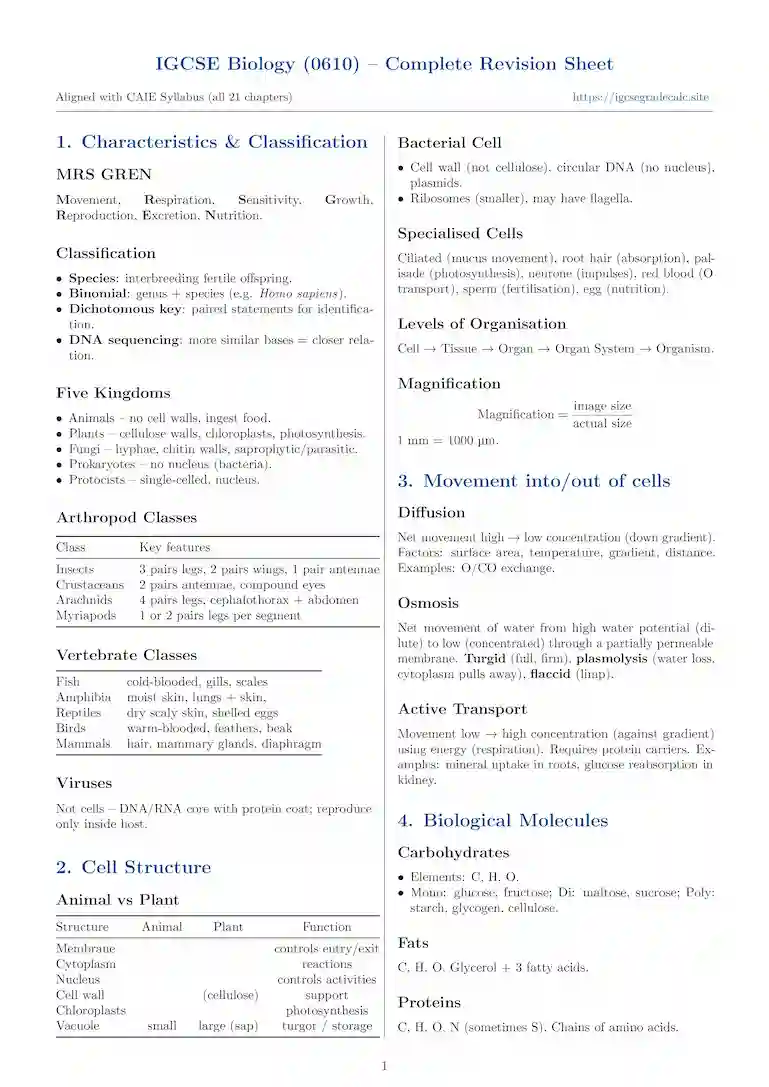
1. Characteristics and Classification of Living Organisms
Living organisms feature a set of shared characteristics regulated by complex cellular processes. Classification helps scientists identify, group, and study species based on evolutionary relationships.
1.1 The Seven Characteristics of Life (MRS GREN)
- Movement: An action by an organism or part of an organism causing a change of position or place. Plants show growth movements (tropisms), while animals move whole bodies.
- Respiration: Chemical reactions in cells that break down nutrient molecules (such as glucose) and release energy for metabolic processes.
- Sensitivity: The ability to detect and sense changes in the internal or external environment (stimuli) and make appropriate, coordinated responses.
- Growth: A permanent increase in size and dry mass by an increase in cell number, cell size, or both.
- Reproduction: The biological processes that create more of the same kind of organism, ensuring species survival via sexual or asexual means.
- Excretion: Removal from organisms of toxic waste products of metabolism, poisonous substances, and materials in excess of requirements (e.g., CO₂, urea).
- Nutrition: Taking in of materials (e.g., proteins, fats, carbohydrates, minerals, water) for energy, growth, and cellular repair.
1.2 Classification System Framework & Phylogenetics
Organisms are grouped into logical categories using shared physical, physiological, and genetic features. Modern classification relies heavily on base sequences in DNA and amino acid sequences in proteins rather than solely on morphology.
The binomial system is an internationally agreed system in which the scientific name of an organism is made up of two words: the Genus (capitalized) followed by the species (lowercase), written in italics (e.g., Homo sapiens or Panthera leo).
1.3 The Five Kingdoms of Life
| Kingdom | Cellular Structure | Nutritional Method | Key Distinct Features |
|---|---|---|---|
| Animals | Multicellular; nucleus present; no cell walls | Heterotrophic (ingests food) | Nervous coordination; store carbohydrates as glycogen |
| Plants | Multicellular; cellulose cell walls; chloroplasts | Autotrophic (photosynthesis) | Store carbohydrates as starch or sucrose |
| Fungi | Multicellular or unicellular; chitin cell walls | Saprotrophic / Heterotrophic | Made of thread-like hyphae forming a mycelium |
| Prokaryotes | Unicellular; peptidoglycan cell walls; no nucleus | Autotrophic or Heterotrophic | Circular loop of DNA (plasmid); lack membrane-bound organelles |
| Protoctists | Mostly unicellular; some have chloroplasts/walls | Autotrophic or Heterotrophic | Dustbin kingdom; includes Amoeba (animal-like) and Chlorella (plant-like) |
1.4 Classification of Vertebrates and Arthropods
Vertebrates (Backbone Present):
- Mammals: Mammary glands, hair/fur, internal fertilization, placenta, warm-blooded (endothermic), external ear pinna.
- Birds: Feathers, beak, hard-shelled eggs, endothermic, forelimbs modified into wings.
- Reptiles: Dry scaly skin, leathery eggs laid on land, cold-blooded (ectothermic).
- Amphibians: Soft moist skin without scales, larvae (tadpoles) have gills, adults have lungs; lay jelly-coated eggs in water.
- Fish: Wet scales, gills for gas exchange, fins, ectothermic, lay eggs in water.
Arthropods (Invertebrates with Exoskeleton and Jointed Legs):
- Insects: 3 body segments (head, thorax, abdomen), 3 pairs of jointed legs, 2 pairs of wings (usually).
- Crustaceans: Covered in exoskeleton, 5 or more pairs of legs, 2 pairs of antennae (e.g., crabs).
- Arachnids: 2 body segments (cephalothorax and abdomen), 4 pairs of legs, no antennae (e.g., spiders).
- Myriapods: Long segmented bodies, many legs (1 or 2 pairs per segment), 1 pair of antennae (e.g., centipedes).
Viruses: Non-living entities consisting only of a genetic material enclosed inside a protective protein coat. They do not carry out metabolic reactions and must parasitize a host cell to replicate.
2. Organisation of the Organism
Cells are the fundamental units of life. Specialized cells organize to form tissues, tissues build organs, organs cooperate in systems, and systems form complete multicellular organisms.
2.1 Cell Structures & Organelles Breakdown
- Cell Wall: Protect the cell, and give the cell a fixed shape.
- Cell Membrane: Partially permeable barrier to control substances into or out of the cell.
- Cytoplasm: Where metabollic reaction takes place.
- Nucleus: Contains genetic material stored in chromosomes (DNA); control all cellular activities and protein synthesis.
- Mitochondria: Double-membrane organelle; primary site of aerobic respiration releasing energy.
- Ribosomes: Synthesizes protein.
- Chloroplasts: Plant-specific organelles packed with chlorophyll pigment; site of light absorption for photosynthesis.
- Vacuole: Large central sap-filled cavity in plant cells (maintains turgidity). Animal cells have small, temporary vacuoles.
2.2 Comparison Between Plant and Animal Cells
| Feature | Plant Cell | Animal Cell |
|---|---|---|
| Cell Wall | Present (Cellulose) | Absent |
| Shape | Fixed, rigid geometric shape | Irregular, flexible shape |
| Chloroplasts | Present in photosynthetic tissues | Absent |
| Vacuole | Large, permanent central vacuole | Small, temporary vacuoles |
| Carbohydrate Storage | Starch grains | Glycogen granules |
2.3 Specialized Cells and Functions
- Ciliated Cells: Movement of mucus in the trachea and bronchi (has cilia).
- Root Hair Cells: Absorption of water and mineral ions (large surface area, thin walls).
- Palisade Mesophyll Cells: Photosynthesis (packed tightly with chloroplasts near upper leaf surface).
- Red Blood Cells: Transport of oxygen (biconcave disc, contains hemoglobin, no nucleus for maximum volume).
- Sperm and Egg Cells: Reproduction (sperm has flagellum and acrosome enzyme cap; egg has haploid nucleus and nutrient cytoplasm).
2.4 Size of Specimens & Magnification Calculations
When calculating magnification, always convert measurement units to match each other before performing division (1 mm = 1000 μm).
3. Movement Into and Out of Cells
Molecules move across membranes via passive transport (diffusion, osmosis) requiring no metabolic energy expenditure, or active transport requiring cellular ATP energy.
3.1 Mechanisms of Transport
- Diffusion: The net movement of particles from a region of higher concentration to lower concentration down a concentration gradient.
- Factors increasing rate: High concentration gradient, temperature, higher surface-area-to-volume ratio, shorter distance/thinner membrane.
- Osmosis: Special case of diffusion: net movement of water molecules from a region of higher water potential (dilute solution) to lower water potential (concentrated solution) through a partially permeable membrane.
- Hypotonic solution (Higher water potential): Plant cells absorb water by osmosis and become turgid (cell wall prevents rupture). Animal cells swell and undergo lysis (bursting).
- Hypertonic solution (Lower water potential): Plant cell contents shrink, membrane detaches from cell wall leading to plasmolysis (flaccid state). Animal cells shrink and become crenated.
- Isotonic solution: Equal water potential inside and outside; no net movement of water.
- Active Transport: The movement of particles through a cell membrane from lower concentration to higher concentration, against a concentration gradient, using energy from respiration via protein carriers.
- Examples: Absorption of glucose by epithelial cells in small intestine villi; uptake of mineral ions (nitrates) by plant root hairs.
4. Biological Molecules
Organic macromolecules form the structural architecture and metabolic machinery of life forms.
4.1 Chemical Structure of Macromolecules
- Carbohydrates: Contain Carbon, Hydrogen, and Oxygen ($C_n H_{2n} O_n$). Monosaccharides (simple sugars like glucose) polymerize to form polysaccharides (starch, glycogen, cellulose).
- Proteins: Made of long chains of amino acids containing Carbon, Hydrogen, Oxygen, Nitrogen, and sometimes Sulfur. Proteins fold into specific 3D shapes held by chemical bonds (crucial for antibodies and enzymes).
- Lipids (Fats & Oils): Made of Carbon, Hydrogen, and Oxygen. Formed from 3 fatty acid molecules bound to 1 glycerol molecule.
- DNA (Deoxyribonucleic Acid): Made of nucleotides containing a sugar, phosphate group, and nitrogenous base (A, T, C, G). Forms a double helix held by complementary base pairs (A-T, C-G).
4.2 Qualitative Food Tests
| Nutrient Target | Reagent / Test Method | Initial Color | Positive Result |
|---|---|---|---|
| Reducing Sugars | Add Benedict's solution and heat in water bath (>80°C) | Blue | Green → Yellow → Brick-Red precipitate |
| Starch | Add Iodine solution drops | Yellow-Brown | Blue-Black color |
| Proteins | Add Biuret reagent (Sodium Hydroxide + Copper Sulfate) | Blue | Purple / Violet color |
| Lipids (Fats) | Dissolve sample in Ethanol, pour into Water (Ethanol Emulsion) | Clear | Milky-white cloudy emulsion |
| Vitamin C | Add DCPIP solution dropwise | Blue | Decolorized (turns clear) |
5. Enzymes
Enzymes are biological catalysts made of proteins that speed up metabolic reaction rates without being changed or used up in the reaction.
5.1 Lock and Key Mechanism & Specificity
- The active site of a specific enzyme has a unique 3D structural shape complementary to its specific substrate molecule.
- Substrate collides with active site, forming an Enzyme-Substrate Complex.
- Reaction occurs, substrate is converted into products, and products are released, leaving the enzyme active site unchanged to repeat the cycle.
5.2 Factors Affecting Enzyme Activity
- Temperature:
- Low temperatures give low kinetic energy; few collisions occur between enzymes and substrates.
- As temperature increases up to the optimum temperature (~37°C in humans), kinetic energy and collision frequency increase.
- Temperatures above optimum disrupt chemical bonds holding enzyme shape. Active site distorts, substrate can no longer fit, and the enzyme is permanently denatured.
- pH Level:
- Every enzyme has an optimum pH (e.g., Pepsin in stomach = pH 2, Trypsin in small intestine = pH 8).
- Extreme pH alterations alter ionic charges and break hydrogen/ionic bonds, changing active site conformation and causing denaturation.
6. Plant Nutrition
Plants are autotrophs that convert solar energy into chemical energy stored within organic molecules.
6.1 Photosynthesis Equations & Process
Photosynthesis is the process by which plants synthesize carbohydrates from raw inorganic materials using light energy absorbed by chlorophyll.
\[ \text{Carbon Dioxide} + \text{Water} \xrightarrow{\text{Light Energy + Chlorophyll}} \text{Glucose} + \text{Oxygen} \] Balanced Chemical Equation:
\[ 6\text{CO}_2 + 6\text{H}_2\text{O} \xrightarrow{\text{Light + Chlorophyll}} \text{C}_6\text{H}_{12}\text{O}_6 + 6\text{O}_2 \]
6.2 Leaf Anatomical Structure & Function
- Waxy Cuticle: Waterproof layer preventing excess water loss via evaporation.
- Upper Epidermis: Thin and transparent layer allowing maximum light penetration to inner photosynthetic tissues.
- Palisade Mesophyll: Long, vertically arranged cells packed with high densities of chloroplasts; main site of photosynthesis.
- Spongy Mesophyll: Loosely arranged cells with large air spaces to facilitate efficient gas diffusion ($\text{CO}_2$ in, $\text{O}_2$ out).
- Vascular Bundle: Xylem delivers water/minerals; Phloem carries away manufactured sucrose/amino acids.
- Stomata & Guard Cells: Microscopic pores on leaf underside; guard cells open and close stomata to balance gas exchange against transpiration water loss.
6.3 Plant Mineral Requirements
- Nitrate Ions ($\text{NO}_3^-$): Required to synthesize amino acids and build proteins. Deficiency leads to stunted growth and yellow older leaves.
- Magnesium Ions ($\text{Mg}^{2+}$): Needed to make chlorophyll molecules. Deficiency causes chlorosis (yellowing between leaf veins).
7. Human Nutrition
Balanced human nutrition requires proper proportions of carbohydrates, fats, proteins, vitamins, minerals, water, and dietary fiber.
7.1 Balanced Diet Requirements & Deficiencies
- Carbohydrates: Primary source of energy (Found in bread, rice, pasta).
- Fats/Lipids: Long-term energy storage, thermal insulation, cell membrane production (Found in butter, oils).
- Proteins: Cellular growth, tissue repair, enzyme and hormone synthesis (Found in meat, fish, eggs, beans).
- Vitamin C: Maintains healthy skin, gums, connective tissue. Deficiency causes scurvy (bleeding gums, slow healing).
- Vitamin D: Aids calcium absorption for strong bones/teeth. Deficiency causes rickets (soft, deformed bones).
- Calcium: Bone density and teeth structure, blood clotting. Deficiency leads to brittle bones/osteoporosis.
- Iron: Essential component of hemoglobin in red blood cells. Deficiency causes anemia (fatigue, pale skin).
- Fiber (Roughage): Provides bulk to food, stimulates peristalsis, prevents constipation (Found in whole grains, vegetables).
7.2 Human Alimentary Canal & Digestive Process
Digestive functions include: Ingestion (taking in food), Digestion (mechanical and chemical breakdown), Absorption (nutrients into blood), Assimilation (nutrients used by cells), and Egestion (expulsion of undigested feces via anus).
7.3 Mechanical vs Chemical Digestion & Enzymes
- Mechanical Digestion: Physical breakdown of large food pieces into smaller fragments without chemical structure change. Increases surface area for enzymes (e.g., teeth chewing, stomach churning, bile emulsification).
- Chemical Digestion: Enzymatic cleavage of insoluble macromolecular polymers into small, soluble monomer molecules for uptake into bloodstream.
- Amylase: Produced in salivary glands and pancreas. Converts starch $\rightarrow$ maltose.
- Maltase: Secreted in small intestine wall. Converts maltose $\rightarrow$ glucose.
- Proteases (Pepsin & Trypsin): Pepsin (stomach, acid pH 2) and Trypsin (pancreas/small intestine, alkaline pH 8) convert protein $\rightarrow$ peptides $\rightarrow$ amino acids.
- Lipase: Produced in pancreas, works in small intestine. Breaks down lipids $\rightarrow$ fatty acids + glycerol.
- Bile Function: Produced in liver, stored in gallbladder, released into duodenum. Alkaline nature neutralizes hydrochloric acid from stomach. Emulsifies fats (breaks large oil droplets into small droplets), drastically increasing surface area for lipase activity.
- Absorption in the Ileum: Adapted via villi and microvilli to maximize surface area. Thin epithelial layer (one-cell thick), dense capillary network absorbs glucose and amino acids; lacteals absorb fatty acids and glycerol into the lymphatic system.
8. Transport in Plants
Plants possess specialized vascular networks to transport water, inorganic ions, and manufactured organic nutrients throughout roots, stems, and leaves.
8.1 Vascular Bundle Arrangement and Function
- Xylem: Made of dead, hollow, elongated cells joined end-to-end with walls reinforced by lignin. Transports water and dissolved mineral ions unidirectionally from roots up to leaves. Provides structural support.
- Phloem: Composed of living sieve tube elements and companion cells containing cytoplasm but no nuclei. Transports sucrose and amino acids from source regions to sink regions via translocation.
8.2 Transpiration and Uptake Mechanisms
- Root Hair Absorption: Microscopic root hair extensions drastically increase surface area. Water enters hair cells via osmosis; mineral ions enter via active transport against concentration gradients.
- Transpiration Pull: Loss of water vapor from leaf surfaces by evaporation from mesophyll cells, followed by diffusion through open stomata. This creates a suction tension (transpiration pull) pulling continuous water columns upwards through the xylem, held together by cohesion (water-water attraction) and adhesion (water-wall attraction).
- Environmental Effects on Transpiration Rate:
- Temperature: Higher temp increases kinetic energy of water molecules $\rightarrow$ increases transpiration rate.
- Humidity: Higher air humidity decreases concentration gradient of water vapor $\rightarrow$ decreases transpiration rate.
- Wind Speed: Higher wind blows away saturated air layer outside stomata, steepening gradient $\rightarrow$ increases transpiration rate.
- Light Intensity: High light stimulates guard cells to open stomata wider $\rightarrow$ increases transpiration rate.
9. Transport in Animals
The human circulatory system is a double closed system comprising a muscular four-chambered heart, blood vessels, and blood components.
9.1 Double Circulatory System Advantages
Blood passes through the heart twice for every complete circuit of the body:
- Pulmonary Circuit: Heart $\rightarrow$ Lungs $\rightarrow$ Heart (picks up oxygen, expels carbon dioxide under lower pressure to protect delicate lung capillaries).
- Systemic Circuit: Heart $\rightarrow$ Body tissues $\rightarrow$ Heart (delivers oxygenated blood to organs under high pressure to ensure rapid flow rate).
9.2 Structural Differentiation of Blood Vessels
| Vessel Type | Wall Structure | Lumen Size | Pressure & Direction | Specialized Features |
|---|---|---|---|---|
| Arteries | Thick, elastic muscular walls | Narrow lumen relative to diameter | High pressure; carries blood away from heart | Withstands pulsing pressure surges; expands and recoils smoothly |
| Veins | Thin muscular wall, which is less elastic | Wide lumen | Low pressure; carries blood towards heart | Contains internal semilunar valves to prevent backflow of blood |
| Capillaries | Extremely thin wall (one-cell thick endothelium) | Microscopic lumen (red cells pass single file) | Low pressure; site of fluid exchange | Permeable walls allow rapid exchange of gas, nutrients, and wastes |
9.3 Heart Structure & Cardiac Cycle
- Four chambers: Right Atrium, Right Ventricle, Left Atrium, Left Ventricle.
- The Left Ventricle has a much thicker muscular wall than the right ventricle because it must generate high pressure to pump blood around the entire body, whereas the right ventricle only pumps to the lungs.
- Valves: Atrioventricular (AV) valves (tricuspid on right, bicuspid on left) prevent blood returning to atria when ventricles contract. Semilunar valves at pulmonary artery and aorta outlets prevent backflow during ventricular relaxation.
- Coronary Arteries: Supply oxygenated blood to the heart muscle tissue itself. Blockage by fatty cholesterol plaques causes Coronary Heart Disease (CHD), leading to angina or heart attack. Risk factors: high fat diet, smoking, stress, lack of exercise, genetics.
9.4 Blood Components
- Red Blood Cells (Erythrocytes): Transport oxygen attached to hemoglobin protein; lack nucleus, biconcave disk shape.
- White Blood Cells (Leukocytes): Defensive immune response cells.
- Phagocytes: Lobed nucleus; engulf pathogens via phagocytosis and digest them using enzymes.
- Lymphocytes: Large spherical nucleus; synthesize and secrete specific antibodies and antitoxins.
- Platelets: Cell fragments involved in blood clotting. Convert soluble fibrinogen into insoluble fibrin threads to trap blood cells and form a protective scab.
- Plasma: Yellow liquid transporting dissolved nutrients (glucose, amino acids), ions, urea, hormones, carbon dioxide, and heat energy.
10. Diseases and Immunity
Pathogens are disease-causing micro-organisms (viruses, bacteria, fungi, protoctists). The immune system protects the host through physical barriers, cellular defense, and antibody production.
10.1 Immune Defenses & Antibody Action
- Body Barriers: Mechanical (skin, nasal hair) and Chemical (stomach hydrochloric acid, tear lysozymes, respiratory mucus).
- Antigens: Distinctive protein markers present on pathogen surface membranes.
- Antibody Production: Lymphocytes recognize foreign antigens and produce specific antibodies that lock onto matching antigens. Antibodies neutralize pathogens by directly destroying them, marking them for phagocytes, or clumping them together (agglutination).
- Active vs Passive Immunity:
- Active Immunity: Defense acquired after stimulation of lymphocytes by antigens (via natural infection or vaccination). Long-term protection because memory cells are produced.
- Passive Immunity: Short-term defense acquired by acquiring ready-made antibodies from another organism (e.g., breastmilk/placenta to fetus, antivenom injections). No memory cells are produced.
- Vaccination Mechanism: Injection of harmless, dead, or weakened (attenuated) forms of a pathogen. Stimulates lymphocytes to undergo division and form specific antibodies and long-lived memory cells without causing disease. Upon future exposure, memory cells mount a rapid, intense secondary immune response before symptoms develop.
11. Gas Exchange and Respiration
Respiration is the cellular metabolic release of energy from organic molecules. Gas exchange provides oxygen for aerobic respiration and excretes carbon dioxide waste.
11.1 Human Gas Exchange System Architecture
- Air path: Nose/Mouth $\rightarrow$ Larynx $\rightarrow$ Trachea $\rightarrow$ Bronchi $\rightarrow$ Bronchioles $\rightarrow$ Alveoli.
- Trachea & Bronchi Protection: Lined with goblet cells that produce sticky mucus to trap inhaled dust/pathogens, and ciliated cells whose beating cilia sweep mucus upwards away from lungs toward the throat to be swallowed.
- Alveoli Adaptations for Diffusion: Millions of tiny air sacs creating a massive surface area; extremely thin walls (one cell thick layer); dense network of blood capillaries; moist surface lining to dissolve gases prior to diffusion.
11.2 Ventilation Mechanics
| Action Phase | Intercostal Muscles | Ribcage Movement | Diaphragm Action | Thoracic Volume & Pressure |
|---|---|---|---|---|
| Inspiration (Inhaling) | External intercostals contract; internal relax | Pushed Upwards and Outwards | Contracts and flattens downwards | Volume increases $\rightarrow$ Internal pressure drops below atmospheric $\rightarrow$ Air pulled in |
| Expiration (Exhaling) | Internal intercostals contract; external relax | Moves Downwards and Inwards | Relaxes and arches upwards into dome shape | Volume decreases $\rightarrow$ Internal pressure rises above atmospheric $\rightarrow$ Air forced out |
11.3 Aerobic vs Anaerobic Respiration
\[ \text{C}_6\text{H}_{12}\text{O}_6 + 6\text{O}_2 \rightarrow 6\text{CO}_2 + 6\text{H}_2\text{O} + \text{Energy (ATP)} \]
Anaerobic Respiration (No Oxygen required; Partial glucose breakdown; Yields low ATP):
1. Human Muscles (Vigorous exercise):
\[ \text{C}_6\text{H}_{12}\text{O}_6 \rightarrow 2\text{Lactic Acid} + \text{Energy} \] *(Causes muscle fatigue and creates an oxygen debt that must be repaid post-exercise by continuing rapid breathing to oxidize lactic acid in the liver).*
2. Yeast Cells (Alcoholic Fermentation):
\[ \text{C}_6\text{H}_{12}\text{O}_6 \rightarrow 2\text{Ethanol} + 2\text{CO}_2 + \text{Energy} \] *(Utilized commercially in bread making to make dough rise, and in brewing alcoholic beverages).*
12. Coordination and Response
Organisms respond to changes in their environment using electrical signals (nervous system) and chemical messengers (hormonal endocrine system).
12.1 Nervous System & Reflex Arc Action
The Central Nervous System (CNS) consists of the Brain and Spinal Cord connected to peripheral sensory and motor neurones.
A Reflex Arc is an automatic, involuntary, and rapid response to a stimulus that protects the body from damage without involving conscious thought processes.
12.2 Synaptic Transmission
- A synapse is a small junction gap between two adjacent neurones.
- When an electrical impulse reaches the axon terminal of the pre-synaptic neurone, it triggers the release of chemical neurotransmitters from vesicles.
- Neurotransmitters diffuse across the synaptic gap down a concentration gradient and bind to complementary receptor proteins on the post-synaptic membrane, triggering a new electrical impulse.
- Synaptic diffusion ensures that impulses travel strictly in one direction only.
12.3 Human Eye Structure & Accommodation
- Cornea: Transparent front layer that refracts light entering the eye.
- Iris & Pupil: Iris controls pupil diameter to adjust light entry (Pupillary Light Reflex: bright light $\rightarrow$ circular muscles contract, radial relax, pupil constricts; dim light $\rightarrow$ radial muscles contract, circular relax, pupil dilates).
- Lens: Fine-tunes light refraction to focus clear images onto the retina.
- Retina: Light-sensitive inner lining containing Rods (vision in low light, black and white) and Cones (high visual acuity, color vision: Red, Green, Blue types).
- Focusing on Near vs Distant Objects (Accommodation):
- Distant Object: Ciliary muscles relax $\rightarrow$ Suspensory ligaments pulled tight $\rightarrow$ Lens pulled thin and flat $\rightarrow$ Less refraction.
- Near Object: Ciliary muscles contract $\rightarrow$ Suspensory ligaments slacken/loosen $\rightarrow$ Lens becomes thick and rounded $\rightarrow$ High refraction.
12.4 Homeostasis & Hormones
Homeostasis: The maintenance of a constant internal body environment within restricted physiological limits (e.g., blood glucose concentration, body temperature, water potential).
- Negative Feedback: A control mechanism where any change from the normal set point triggers a corrective homeostatic response to bring conditions back to normal.
- Control of Blood Glucose:
- High Blood Glucose: Pancreas secretes Insulin hormone $\rightarrow$ Stimulates liver and muscle cells to absorb glucose and convert it into stored glycogen.
- Low Blood Glucose: Pancreas secretes Glucagon hormone $\rightarrow$ Stimulates liver cells to break down stored glycogen back into glucose and release it into the bloodstream.
- Thermoregulation (Skin Action):
- Too Warm: Sweat glands secrete sweat (evaporative cooling); Vasodilation occurs (arterioles supplying skin capillaries dilate, increasing blood flow to skin surface to radiate heat).
- Too Cold: Skeletal muscles shiver (metabolic heat production); Vasoconstriction occurs (arterioles supplying skin capillaries constrict, reducing blood flow near surface to conserve heat); erector muscles contract causing hair to stand on end (traps insulating air layer).
- Plant Tropisms: Growth movements controlled by the plant hormone Auxin. Auxin is made in the stem tip and stimulates cell elongation. In stems, auxin accumulates on the shaded side (phototropism) and lower side (gravitropism), causing greater cell elongation on that side and making the stem bend toward light and away from gravity.
13. Reproduction
Reproductive pathways maintain biological population continuity through asexual duplication or sexual genetic recombination.
13.1 Asexual vs Sexual Reproduction
| Feature | Asexual Reproduction | Sexual Reproduction |
|---|---|---|
| Number of Parents | One single parent | Two parents (male and female) |
| Gamete Fusion | No gametes involved | Fusion of haploid gamete nuclei (fertilization) |
| Genetic Variation | Offspring are genetically identical clones | Offspring are genetically unique |
| Cell Division Type | Mitosis division | Meiosis to form gametes; Mitosis post-zygote |
| Environmental Advantage | Rapid population expansion in stable conditions | Adaptability to changing environments via variation |
13.2 Plant Sexual Reproduction & Pollination
- Flower Parts: Sepals (protect bud), Petals (attract pollinators), Anther/Stamen (male part producing pollen grains), Stigma/Style/Ovary (female carpel components).
- Insect-Pollinated vs Wind-Pollinated Flowers: Insect flowers have large, brightly colored petals, scent, nectar, and sticky pollen inside the flower. Wind flowers have small green petals, no scent/nectar, long dangling filaments with external anthers, and feathery external stigmas to catch airborne pollen.
- Fertilization: Pollen grain lands on stigma $\rightarrow$ Grows a pollen tube down through style into ovary $\rightarrow$ Male nucleus travels down tube to fuse with egg cell nucleus inside ovule $\rightarrow$ Ovule becomes seed, ovary wall becomes fruit.
- Germination Conditions: Requires Water (rehydrates seed and activates enzymes), Oxygen (for aerobic respiration), and Warmth/Temperature (for optimum enzyme function). Light is not required for initial germination.
13.3 Human Reproduction & Menstrual Cycle
- Gametes: Sperm (male gamete made in testes; small, motile flagellum, acrosome cap) and Egg/Ovum (female gamete made in ovaries; large, non-motile, nutrient-rich cytoplasm).
- Fertilization Path: Sperm deposited in vagina $\rightarrow$ Swims through cervix and uterus $\rightarrow$ Encounters egg in the Oviduct (Fallopian tube) $\rightarrow$ Nuclei fuse forming diploid zygote $\rightarrow$ Zygote divides into embryo $\rightarrow$ Implants into uterus lining.
- Placenta Functions: Allows exchange of oxygen, glucose, amino acids, and antibodies from maternal blood to fetal blood by diffusion across a thin membrane; removes fetal waste products (carbon dioxide, urea). Prevents mixing of maternal and fetal blood to protect against pressure differences and immune rejection.
- Hormonal Control of Menstrual Cycle:
- FSH (Follicle Stimulating Hormone): Secreted by pituitary gland; causes egg maturation in ovary and stimulates estrogen production.
- Estrogen: Secreted by ovaries; repairs and thickens uterus lining; inhibits FSH and triggers LH release.
- LH (Luteinizing Hormone): Secreted by pituitary gland; surge causes ovulation (egg release on day 14).
- Progesterone: Secreted by empty follicle (corpus luteum); maintains thick uterus lining for embryo implantation. If no fertilization occurs, progesterone drops, triggering menstruation.
14. Inheritance and Genetic Technology
Genetics studies how inheritance rules transfer traits from parents to offspring via DNA code, genes, and alleles.
14.1 Key Genetic Definitions
- Chromosome: A thread-like structure of DNA carrying genetic information in the form of genes. Humans have 23 pairs (46 total) in somatic diploid cells.
- Gene: A length of DNA that codes for a specific protein.
- Allele: An alternative form of a specific gene (e.g., blood group alleles $I^A, I^B, I^O$).
- Haploid Nucleus ($n$): Contains a single set of unpaired chromosomes (23 in human gametes).
- Diploid Nucleus ($2n$): Contains two complete sets of paired chromosomes (46 in human body cells).
- Genotype: The genetic makeup of an organism in terms of the alleles present (e.g., $Bb, BB, bb$).
- Phenotype: The observable physical or physiological features of an organism resulting from genotype and environmental interaction (e.g., Blue eyes).
- Homozygous: Having two identical alleles for a particular gene (e.g., $BB$ or $bb$).
- Heterozygous: Having two different alleles for a particular gene (e.g., $Bb$).
- Dominant Allele: An allele that is expressed if present in genotype ($B$).
- Recessive Allele: An allele that is only expressed when no dominant allele is present ($b$, homozygous condition).
14.2 Mitosis vs Meiosis Nuclear Divisions
| Comparison Aspect | Mitosis | Meiosis |
|---|---|---|
| Purpose / Function | Growth, tissue repair, asexual reproduction | Production of gametes for sexual reproduction |
| Location in Body | All somatic body cells | Reproductive organs (testes/ovaries; anthers/ovules) |
| Number of Divisions | One nuclear division | Two successive nuclear divisions |
| Daughter Cells Produced | 2 diploid ($2n$) daughter cells | 4 haploid ($n$) daughter cells |
| Genetic Variation | Daughter cells are genetically identical clones | Genetic variation introduced via independent assortment/crossing over |
14.3 Monohybrid Crosses & Inheritance Patterns
A genetic cross using a Punnett square determines probability ratios for offspring genotypes and phenotypes.
Sex Determination: Females carry $XX$ sex chromosomes; Males carry $XY$ sex chromosomes. The father's sperm determines child sex (50% chance $X$, 50% chance $Y$).
Sex-Linked Characteristics: Genes located on the $X$ chromosome where females have two copies ($X^R X^r$) but males have only one ($X^r Y$). Recessive sex-linked conditions (such as red-green color blindness and hemophilia) are far more common in males because males cannot be heterozygous carriers—a single recessive allele on the $X$ chromosome is expressed.
Protein Synthesis: Gene DNA sequence $\rightarrow$ copied into mRNA in nucleus $\rightarrow$ mRNA moves out to ribosome $\rightarrow$ Ribosome reads nucleotide triplets (codons) and links specific amino acids together to assemble the functional protein.
14.4 Genetic Technology & Engineering
Genetic Engineering: Modifying the genome of an organism by inserting a gene from another species to express desired traits.
Mass Production of Human Insulin in Bacteria Steps:
- Human gene for insulin is identified and cut out from human DNA using a specific Restriction Enzyme, creating complementary "sticky ends".
- Bacterial plasmid DNA vector is extracted and cut open using the same restriction enzyme, producing matching sticky ends.
- Human insulin gene and cut plasmid are joined together using the enzyme DNA Ligase to form a Recombinant Plasmid.
- Recombinant plasmid is inserted back into host E. coli bacteria cells.
- Transgenic bacteria are grown in large-scale industrial fermenters with controlled temperature, pH, and oxygen to replicate rapidly and produce large quantities of human insulin.
- Insulin is extracted, purified, and bottled for diabetic clinical use.
Related Sources & Resources:
Other Subject Revision Notes:
- IGCSE ICT Complete Revision Notes
- IGCSE Chemistry Revision Notes
- IGCSE Additional Mathematics Revision Notes
- IGCSE Economics Revision Notes