IGCSE Chemistry (0620)
Revision Notes
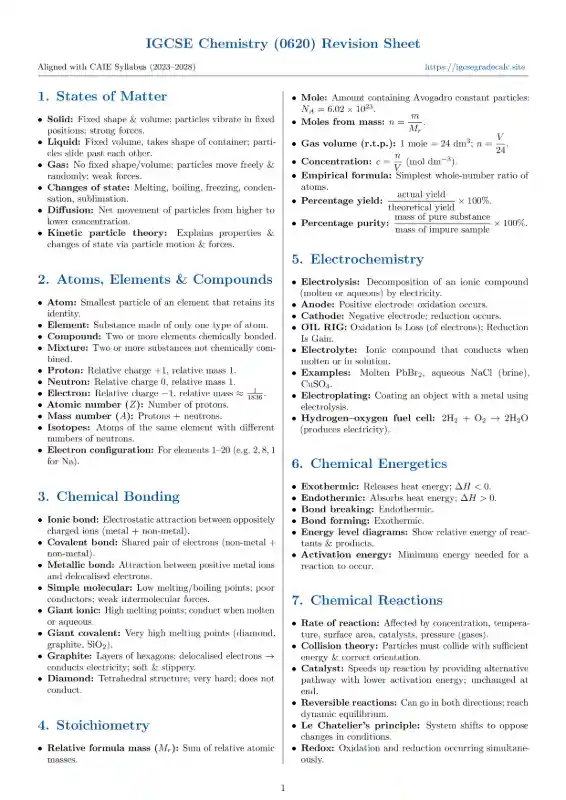
1. States of Matter
The kinetic particle theory defines physical configurations based on particle distance, arrangement, and velocity profile. Changes in state are physical changes that involve changes in kinetic energy, intermolecular forces, and particle separation without altering chemical composition.
1.1 Arrangement, Movement, and Energy
- Solids: Fixed shape and volume. Particles are tightly packed in a regular lattice structure, held by strong intermolecular forces. Movement is restricted to subtle vibrations around fixed positions. Lowest kinetic energy state. High density, non-compressible.
- Liquids: Fixed volume, variable shape (takes the shape of the container base). Particles are closely spaced but arranged randomly. Intermolecular forces are weaker than in solids, allowing particles to slide past one another. Intermediate kinetic energy state. High density, non-compressible.
- Gases: Variable shape and volume (fills any enclosed space). Particles are widely separated with virtually no intermolecular attraction. Particles move at high velocities, rapidly and randomly in straight lines, undergoing elastic collisions with container walls to exert gas pressure. Highest kinetic energy state. Low density, highly compressible.
1.2 Heating and Cooling Curves Analysis
When a solid is heated, thermal energy increases particle vibration until the temperature reaches the melting point. During phase transitions (melting and boiling), added thermal energy breaks intermolecular bonds rather than increasing kinetic energy; therefore, temperature remains completely constant (plateau period) until the change of state is complete.
1.3 Diffusion, Mass, and Gas Kinetic Relationships
Diffusion: Net movement of fluid particles from a region of higher concentration to lower concentration down a concentration gradient due to random thermal motion.
- Effect of Temperature: Higher temperatures increase particle kinetic energy, leading to faster movement and higher collision frequencies, which accelerates diffusion speed.
- Effect of Relative Molecular Mass (\(M_r\)): Lighter gas particles move with higher average velocities than heavier particles at the same temperature.
Classic IGCSE Lab Demonstration: Ammonia gas (\(\text{NH}_3\), \(M_r = 17\)) reacting with Hydrogen Chloride gas (\(\text{HCl}\), \(M_r = 36.5\)) in a glass tube. The white ring precipitate of Ammonium Chloride (\(\text{NH}_4\text{Cl}\)) forms closer to the \(\text{HCl}\) source because lighter \(\text{NH}_3\) diffuses faster than heavier \(\text{HCl}\).
2. Experimental Techniques and Chemical Analysis
Precision measurement, separation methodologies, and strict analytical verification steps guarantee purity in chemical processing.
2.1 Separation, Purification, and Chromatography
- Filtration: Separates an insoluble solid solute from a liquid solvent phase using filter paper. Residue stays on paper; filtrate passes through.
- Crystallization: Recovers a dissolved crystalline solute from solution. Heat solution to saturation point (tested via glass rod dip), allow slow cooling for crystal growth, filter, and dry between filter papers.
- Simple Distillation: Separates a volatile liquid solvent from a non-volatile dissolved solid solute based on boiling point differences (e.g., pure water from seawater).
- Fractional Distillation: Separates miscible liquids with close boiling points (e.g., ethanol/water, crude oil, liquid air). Uses a fractionating column filled with glass beads to provide surface area for repeated condensation and evaporation cycles. Liquid with the lowest boiling point distills over first.
- Paper Chromatography: Separates soluble components (inks, dyes, sugars) using solvent capillary action on paper.
- Pencil is used for the baseline because graphite is insoluble and won't interfere with chromatograms.
- The solvent level must stay below the baseline to prevent sample spots from dissolving directly into the bath.
- Locating agents (e.g., ninhydrin) reveal colorless spots like amino acids.
2.2 Qualitative Analysis: Cation Identification Matrix
| Cation Ion | Aqueous Sodium Hydroxide (\(\text{NaOH}\)) | Aqueous Ammonia (\(\text{NH}_3\)) |
|---|---|---|
| Aluminum (\(\text{Al}^{3+}\)) | White precipitate, dissolves in excess to form a colorless solution | White precipitate, insoluble in excess |
| Ammonium (\(\text{NH}_4^+\)) | Ammonia gas evolved on warming (\(\text{NH}_3\) gas turns damp red litmus blue) | No reaction / N/A |
| Calcium (\(\text{Ca}^{2+}\)) | White precipitate, insoluble in excess | No precipitate or faint white trace |
| Chromium(III) (\(\text{Cr}^{3+}\)) | Green precipitate, dissolves in excess to give a green solution | Grey-green precipitate, insoluble in excess |
| Copper(II) (\(\text{Cu}^{2+}\)) | Light blue precipitate, insoluble in excess | Light blue precipitate, dissolves in excess to give a deep dark blue solution |
| Iron(II) (\(\text{Fe}^{2+}\)) | Green precipitate, insoluble in excess (turns brown at surface over time) | Green precipitate, insoluble in excess |
| Iron(III) (\(\text{Fe}^{3+}\)) | Red-brown precipitate, insoluble in excess | Red-brown precipitate, insoluble in excess |
| Zinc (\(\text{Zn}^{2+}\)) | White precipitate, dissolves in excess to form a colorless solution | White precipitate, dissolves in excess to form a colorless solution |
2.3 Qualitative Analysis: Anion & Flame Verification Protocols
| Anion | Test Reagents and Steps | Observation Result |
|---|---|---|
| Carbonate (\(\text{CO}_3^{2-}\)) | Add dilute acid (\(\text{HCl}\) or \(\text{HNO}_3\)) | Effervescence; gas produced (\(\text{CO}_2\)) turns limewater milky |
| Chloride (\(\text{Cl}^-\)) | Acidify with dilute \(\text{HNO}_3\), add aqueous \(\text{AgNO}_3\) | White precipitate of Silver Chloride (\(\text{AgCl}\)) |
| Bromide (\(\text{Br}^-\)) | Acidify with dilute \(\text{HNO}_3\), add aqueous \(\text{AgNO}_3\) | Cream precipitate of Silver Bromide (\(\text{AgBr}\)) |
| Iodide (\(\text{I}^-\)) | Acidify with dilute \(\text{HNO}_3\), add aqueous \(\text{AgNO}_3\) | Yellow precipitate of Silver Iodide (\(\text{AgI}\)) |
| Nitrate (\(\text{NO}_3^-\)) | Add aqueous \(\text{NaOH}\), add aluminum foil, warm gently | Pungent \(\text{NH}_3\) gas produced; turns damp red litmus paper blue |
| Sulfate (\(\text{SO}_4^{2-}\)) | Acidify with dilute \(\text{HNO}_3\), add aqueous \(\text{Ba(NO}_3)_2\) or \(\text{BaCl}_2\) | White precipitate of Barium Sulfate (\(\text{BaSO}_4\)) |
| Sulfite (\(\text{SO}_3^{2-}\)) | Add dilute \(\text{HCl}\), warm gently, test evolved gas | \(\text{SO}_2\) gas evolved turns acidified aqueous \(\text{KMnO}_4\) from purple to colorless |
2.4 Flame Tests & Gas Tests
- Flame Colors: Lithium (\(\text{Li}^+\)) = Red | Sodium (\(\text{Na}^+\)) = Yellow | Potassium (\(\text{K}^+\)) = Lilac | Calcium (\(\text{Ca}^{2+}\)) = Orange-Red | Copper(II) (\(\text{Cu}^{2+}\)) = Blue-Green.
- Gas Tests:
- Ammonia (\(\text{NH}_3\)): Pungent odor, turns damp red litmus paper blue.
- Carbon Dioxide (\(\text{CO}_2\)): Bubbled through limewater, turns solution milky/cloudy.
- Chlorine (\(\text{Cl}_2\)): Bleaches damp litmus paper white.
- Hydrogen (\(\text{H}_2\)): Holds a lighted splint, burns with a sharp 'pop' sound.
- Oxygen (\(\text{O}_2\)): Relights a glowing splint.
- Sulfur Dioxide (\(\text{SO}_2\)): Turns acidified aqueous Potassium Manganate(VII) from purple to colorless.
3. Atoms, Elements and Compounds
The subatomic makeup of elements determines their physical structure, chemical bonding, and location in the periodic table.
3.1 Atomic Framework, Subatomic Particles, and Isotopes
An atom consists of a dense central nucleus containing protons and neutrons, surrounded by electrons in shells. Atomic structure notation is \({}_{Z}^{A}\text{X}\), where \(A\) is the Nucleon (Mass) Number and \(Z\) is the Proton (Atomic) Number.
| Subatomic Particle | Relative Mass | Relative Charge | Location in Atom |
|---|---|---|---|
| Proton (\(p\)) | 1 | +1 | Nucleus |
| Neutron (\(n\)) | 1 | 0 (Neutral) | Nucleus |
| Electron (\(e^-\)) | \(1/1840\) (Negligible) | -1 | Electron Shells |
3.2 Chemical Bonding Types & Structural Lattice Properties
- Ionic Bonding: Strong electrostatic attraction between oppositely charged cations and anions, formed by electron transfer from metals to non-metals.
- Properties: High melting/boiling points due to strong ionic lattice bonds. Conducts electricity when molten or aqueous (free-moving ions), but not as a solid (ions fixed in lattice). Typically soluble in water.
- Covalent Bonding: Electrostatic attraction between shared electron pairs and two adjacent positive nuclei. Occurs between non-metals.
- Simple Molecular Structures (\(\text{H}_2\text{O}, \text{CH}_4, \text{CO}_2\)): Low melting/boiling points because only weak intermolecular forces (van der Waals) break during heating, leaving covalent bonds intact. Electrical non-conductors due to lack of free mobile charge carriers.
- Giant Covalent Networks (Allotropes of Carbon & Silicon Dioxide):
- Diamond: Each carbon covalently bonded to 4 others in a rigid 3D tetrahedral lattice. Extremely hard, high melting point, non-conductor. Used in cutting tools.
- Graphite: Each carbon covalently bonded to 3 others in 2D hexagonal layers held by weak intermolecular forces. Layers slide past each other easily (lubricant). Contains 1 delocalized electron per carbon, allowing high electrical conductivity along layers.
- Silicon Dioxide (\(\text{SiO}_2\)): Each Silicon atom bonds to 4 Oxygen atoms, each Oxygen bonds to 2 Silicon atoms. High melting point, hard, structural analog to diamond.
- Metallic Bonding: Electrostatic attraction between a regular lattice of positive metal cations and a surrounding mobile 'sea' of delocalized valence electrons.
- Properties: Excellent electrical and thermal conductors (delocalized electrons move freely). Malleable and ductile because metal ions slide past each other into new positions without breaking the metallic bond framework.
4. Stoichiometry
Stoichiometry calculates masses, gas volumes, and solution concentrations using the mole concept.
4.1 Comprehensive Mole Equations
A mole is defined as \(6.02 \times 10^{23}\) particles (the Avogadro constant). Relative atomic mass (\(A_r\)) and relative molecular mass (\(M_r\)) represent mass relative to \(1/12\text{th}\) the mass of Carbon-12.
4.2 Empirical and Molecular Formulas
- Empirical Formula: Simplest whole-number ratio of atoms of each element present in a compound. Calculated by converting mass/percentage of each element to moles (\(\text{Mass} / A_r\)) and simplifying to the lowest ratio.
- Molecular Formula: The actual number of atoms of each element in one molecule of a compound. Calculated using empirical formula mass and total $M_r$: \[ \text{Multiplier } n = \frac{\text{Relative Molecular Mass } M_r}{\text{Empirical Formula Mass}} \] \[ \text{Molecular Formula} = n \times (\text{Empirical Formula}) \]
4.3 Yield, Purity, and Limiting Reactants
Limiting Reactant Concept: The reactant that is completely consumed first in a chemical reaction. It determines the maximum theoretical yield of products formed.
5. Electricity and Chemistry (Electrolysis)
Electrolysis uses direct current (DC) electricity to decompose ionic compounds in a molten state or aqueous solution.
5.1 Core Mechanisms & Discharge Rules
- Anode (+): Positive electrode where negative anions lose electrons (\text{Oxidation}).
- Cathode (-): Negative electrode where positive cations gain electrons (\text{Reduction}).
- Aqueous Discharge Rules at Cathode (-): Hydrogen gas (\(\text{H}_2\)) is discharged unless the metal cation is lower than Hydrogen in the reactivity series (e.g., \(\text{Cu}^{2+}, \text{Ag}^+\)).
- Aqueous Discharge Rules at Anode (+): Halide ions (\(\text{Cl}^-, \text{Br}^-, \text{I}^-\)) are discharged as halogen gases if concentrated. If no halide is present or if dilute, Hydroxide ions (\(\text{OH}^-\)) discharge to produce Oxygen gas (\(\text{O}_2\)): \[ 4\text{OH}^- \rightarrow \text{O}_2 + 2\text{H}_2\text{O} + 4e^- \]
5.2 Detailed Electrolysis Applications
| Electrolyte System | Cathode (-) Product & Half Equation | Anode (+) Product & Half Equation |
|---|---|---|
| Molten Lead(II) Bromide (\(\text{PbBr}_2\)) | Lead metal droplets (\(\text{Pb}\)) \[ \text{Pb}^{2+} + 2e^- \rightarrow \text{Pb} \] |
Pungent brown Bromine gas (\(\text{Br}_2\)) \[ 2\text{Br}^- \rightarrow \text{Br}_2 + 2e^- \] |
| Concentrated Aqueous \(\text{NaCl}\) (Brine) | Hydrogen gas (\(\text{H}_2\)) \[ 2\text{H}^+ + 2e^- \rightarrow \text{H}_2 \] |
Chlorine gas (\(\text{Cl}_2\)) \[ 2\text{Cl}^- \rightarrow \text{Cl}_2 + 2e^- \] |
| Dilute Sulfuric Acid (\(\text{H}_2\text{SO}_4\)) | Hydrogen gas (\(\text{H}_2\)) \[ 2\text{H}^+ + 2e^- \rightarrow \text{H}_2 \] |
Oxygen gas (\(\text{O}_2\)) \[ 4\text{OH}^- \rightarrow \text{O}_2 + 2\text{H}_2\text{O} + 4e^- \] |
| Aqueous Copper(II) Sulfate (Inert Carbon Electrodes) | Pink-brown Copper metal layer (\(\text{Cu}\)) \[ \text{Cu}^{2+} + 2e^- \rightarrow \text{Cu} \] |
Oxygen gas (\(\text{O}_2\)) \[ 4\text{OH}^- \rightarrow \text{O}_2 + 2\text{H}_2\text{O} + 4e^- \] |
5.3 Electroplating, Copper Refining, and Hydrogen Fuel Cells
- Electroplating: Coating a metal object with a layer of another metal (e.g., silver plating) for corrosion protection or improved appearance.
- Anode (+): Pure plating metal (e.g., Silver strip).
- Cathode (-): Object to be plated (e.g., steel spoon).
- Electrolyte: Soluble salt solution containing the plating metal ion (e.g., \(\text{AgNO}_3\)).
- Copper Refining: Impure copper anode dissolves (\(\text{Cu} \rightarrow \text{Cu}^{2+} + 2e^-\)); pure copper deposits on cathode (\(\text{Cu}^{2+} + 2e^- \rightarrow \text{Cu}\)). Impurities settle at the bottom as anode sludge.
- Hydrogen Fuel Cells: Combines Hydrogen and Oxygen fuel to produce clean electricity continuously, emitting only water vapor.
- Overall equation: \[ 2\text{H}_2 + \text{O}_2 \rightarrow 2\text{H}_2\text{O} \]
- Advantages over petrol engines: Zero toxic carbon pollutants produced; higher efficiency in energy conversion.
6. Chemical Energetics
Thermodynamics tracks enthalpy changes (\(\Delta H\)) and thermal energy transfers during chemical transformations.
6.1 Exothermic vs. Endothermic Reactions
- Exothermic Reactions: Release thermal energy to the surroundings. Surrounding temperature increases. \(\Delta H\) is negative. (e.g., Combustion, neutralization, respiration).
- Endothermic Reactions: Absorb thermal energy from the surroundings. Surrounding temperature decreases. \(\Delta H\) is positive. (e.g., Thermal decomposition, photosynthesis, citric acid + baking soda).
6.2 Energy Level Profiles & Activation Energy
Activation Energy (\(E_a\)) is the minimum energy required by colliding particles to break initial bonds and start a reaction.
- Exothermic Profile: Reactant energy level is higher than product energy level. Net energy drops.
- Endothermic Profile: Reactant energy level is lower than product energy level. Net energy rises.
- Catalyst Effect: Lowers the activation energy peak by providing an alternative pathway, without altering the overall enthalpy change (\(\Delta H\)).
6.3 Enthalpy Calculation via Bond Energies
Bond breaking is an endothermic process (absorbs energy). Bond making is an exothermic process (releases energy).
If \(\sum(\text{Forming}) > \sum(\text{Breaking})\) \(\rightarrow\) Exothermic (\(\Delta H < 0\))
7. Chemical Reactions
Reaction kinetics and dynamic equilibria describe collision frequencies and conditions for maximum yield.
7.1 Collision Theory and Rate Determinants
A chemical reaction occurs when reacting particles collide with kinetic energy greater than or equal to the activation energy (\(E_a\)) and with correct orientation.
- Increasing Concentration/Pressure: Increases the number of particles per unit volume \(\rightarrow\) increases collision frequency.
- Increasing Temperature: Particles gain kinetic energy, move faster, and collide more frequently. Crucially, a much higher fraction of particles have energy \(\ge E_a\), leading to a higher percentage of successful collisions.
- Increasing Surface Area (Smaller Powder Sizes): Exposes more reactant particles to collisions \(\rightarrow\) increases collision frequency per unit time.
- Adding Catalysts: Provides an alternative reaction pathway with lower activation energy \(\rightarrow\) increases the proportion of successful collisions without the catalyst being consumed.
7.2 Reversible Reactions, Dynamic Equilibria, & Le Chatelier's Principle
A reaction is reversible when products can react to reform the original reactants. Dynamic Equilibrium is reached in a closed system when the rate of the forward reaction equals the rate of the reverse reaction, keeping the concentrations of reactants and products constant.
- Temperature Increase: Shifts equilibrium in the endothermic direction to absorb added heat.
- Pressure Increase: Shifts equilibrium toward the side with fewer gas moles.
- Concentration Increase: Shifts equilibrium away from the added component to consume it.
- Catalysts: Speeds up forward and reverse rates equally; does not alter equilibrium yield.
7.3 Industrial Synthesis Master Reference
| Industrial Synthesis | Reversible Equation & Enthalpy | Compromise Industrial Conditions |
|---|---|---|
| Haber Process (Ammonia) | \[ \text{N}_2\text{(g)} + 3\text{H}_2\text{(g)} \rightleftharpoons 2\text{NH}_3\text{(g)} \quad (\Delta H = -92 \text{ kJ/mol}) \] |
Temperature: \(450^\circ\text{C}\) (Compromise yield/rate) Pressure: \(200 \text{ atm}\) (High yield & rate) Catalyst: Finely divided Iron (\(\text{Fe}\)) |
| Contact Process (Sulfuric Acid) | \[ 2\text{SO}_2\text{(g)} + \text{O}_2\text{(g)} \rightleftharpoons 2\text{SO}_3\text{(g)} \quad (\Delta H = -197 \text{ kJ/mol}) \] |
Temperature: \(450^\circ\text{C}\) Pressure: \(1-2 \text{ atm}\) (High yield at ambient pressure) Catalyst: Vanadium(V) Oxide (\(\text{V}_2\text{O}_5\)) |
7.4 Redox Chemistry Principles
- Oxidation: Gain of oxygen, loss of hydrogen, loss of electrons (\text{OIL}), or increase in oxidation state.
- Reduction: Loss of oxygen, gain of hydrogen, gain of electrons (\text{RIG}), or decrease in oxidation state.
- Oxidizing Agents: Substances that oxidize another species by gaining electrons (is reduced itself). Example: Acidified \(\text{KMnO}_4\) turns from purple to colorless when reduced.
- Reducing Agents: Substances that reduce another species by donating electrons (is oxidized itself). Example: Aqueous Potassium Iodide (\(\text{KI}\)) turns from colorless to brown when oxidized to \(\text{I}_2\).
8. Acids, Bases and Salts
Acid-base behavior involves proton transfer, pH indicators, oxide classification, and salt preparation strategies.
8.1 Acid-Base Definitions, pH Scale, and Indicators
- Acids: Proton (\(\text{H}^+\)) donors. Strong acids (e.g., \(\text{HCl}, \text{HNO}_3, \text{H}_2\text{SO}_4\)) dissociate completely in water. Weak acids (e.g., \(\text{CH}_3\text{COOH}\)) dissociate only partially.
- Bases / Alkalis: Proton (\(\text{H}^+\)) acceptors. Alkalis are water-soluble bases that release Hydroxide ions (\(\text{OH}^-\)) in aqueous solution. Strong alkalis (e.g., \(\text{NaOH}, \text{KOH}\)) dissociate completely.
| Indicator | Color in Acid | Color at Neutral (pH 7) | Color in Alkali |
|---|---|---|---|
| Litmus Paper | Red | Purple | Blue |
| Methyl Orange | Red | Orange | Yellow |
| Thymolphthalein | Colorless | Colorless | Blue |
| Universal Indicator | Red (pH 0-2) / Orange-Yellow (3-6) | Green | Blue (8-11) / Purple (12-14) |
8.2 Oxide Classification
- Acidic Oxides: Oxides of non-metals (e.g., \(\text{CO}_2, \text{SO}_2\)). React with alkalis to form salt + water.
- Basic Oxides: Oxides of metals (e.g., \(\text{CuO}, \text{CaO}\)). React with acids to form salt + water.
- Amphoteric Oxides: Metal oxides that react with both acids and alkalis to form salt + water (e.g., \(\text{Al}_2\text{O}_3, \text{ZnO}\)).
- Neutral Oxides: Non-metal oxides that react with neither acids nor alkalis (e.g., \(\text{CO}, \text{NO}, \text{H}_2\text{O}\)).
8.3 Salt Solubility Rules & Preparation Pathways
| Soluble Compounds | Insoluble Exceptions |
|---|---|
| All Sodium (\(\text{Na}^+\)), Potassium (\(\text{K}^+\)), and Ammonium (\(\text{NH}_4^+\)) salts | None |
| All Nitrates (\(\text{NO}_3^-\)) | None |
| All Chlorides (\(\text{Cl}^-\)) | Silver Chloride (\(\text{AgCl}\)), Lead(II) Chloride (\(\text{PbCl}_2\)) |
| All Sulfates (\(\text{SO}_4^{2-}\)) | Barium Sulfate (\(\text{BaSO}_4\)), Calcium Sulfate (\(\text{CaSO}_4\)), Lead(II) Sulfate (\(\text{PbSO}_4\)) |
| Sodium, Potassium, and Ammonium Carbonates | All other Carbonates (\(\text{CO}_3^{2-}\)) are insoluble |
| Sodium, Potassium, and Calcium Hydroxides | All other Hydroxides (\(\text{OH}^-\)) are insoluble |
Salt Preparation Method Selection:
- Method 1: Excess Insoluble Base/Metal/Carbonate + Acid (For soluble salts except Group 1/Ammonium): Add excess insoluble reactant to dilute acid, warm if necessary. Filter out excess unreacted solid. Heat filtrate to saturation point, cool to crystallize, filter crystals, and dry between filter paper.
- Method 2: Titration (For Soluble Group 1 and Ammonium Salts): Measure precise acid volume into a conical flask using a pipette. Add indicator. Titrate with alkali from a burette until the endpoint color change occurs. Note exact volume. Repeat using identical volumes without indicator. Evaporate to crystallize.
- Method 3: Precipitation (For Insoluble Salts): Mix two soluble salt solutions. Filter off the insoluble salt precipitate residue. Wash residue with distilled water to clean impurities, then dry in a warm oven.
9. The Periodic Table
Periodic trends reflect electronic configurations and changing proton counts across periods and down groups.
9.1 Periodic Trends Across Periods and Down Groups
- Period Trends (Horizontal Rows): Elements change from metallic to non-metallic from left to right. Proton number increases, valence electrons increase, and oxides transition from basic to amphoteric to acidic.
- Group 1 (Alkali Metals): Soft metals with low densities.
- Reactivity increases down the group as the valence electron is further from the nucleus, experiencing weaker attraction and greater shielding, making it easier to lose.
- Melting points decrease down the group.
- React vigorously with water: \[ 2\text{Na(s)} + 2\text{H}_2\text{O(l)} \rightarrow 2\text{NaOH(aq)} + \text{H}_2\text{(g)} \]
- Group 7 (Halogens): Diatomic non-metals (\(\text{F}_2, \text{Cl}_2, \text{Br}_2, \text{I}_2\)).
- Colors darken down the group: Chlorine (pale green gas) \(\rightarrow\) Bromine (red-brown liquid) \(\rightarrow\) Iodine (grey-black solid / purple vapor).
- Reactivity decreases down the group as the incoming electron experiences weaker attraction to the nucleus due to increased shell distance and shielding.
- Displacement Reactions: A more reactive halogen displaces a less reactive halide ion from aqueous solution: \[ \text{Cl}_2\text{(g)} + 2\text{KBr(aq)} \rightarrow 2\text{KCl(aq)} + \text{Br}_2\text{(aq)} \]
- Group 8/0 (Noble Gases): Monatomic, unreactive gases (\(\text{He, Ne, Ar}\)) with full outer electron shells (stable octet/duplet). Used in inert lighting and welding atmospheres.
9.2 Transition Elements
Transition metals are hard, dense metals with high melting points. Key characteristics include:
- Variable oxidation states (e.g., \(\text{Fe}^{2+}\) vs \(\text{Fe}^{3+}\), \(\text{Cu}^+\) vs \(\text{Cu}^{2+}\)).
- Formation of colorful compounds (e.g., Copper(II) sulfate is blue, Iron(II) salts are green).
- Extensive use as industrial catalysts (e.g., Iron in Haber process, Nickel in hydrogenation, \(\text{V}_2\text{O}_5\) in Contact process).
10. Metals
The reactivity series dictates extraction methodologies, alloy behaviors, and corrosion mitigation techniques.
10.1 Reactivity Series & Displacement Order
Order of reactivity based on ease of forming positive ions:
- Metals above Carbon are extracted via electrolysis (requires high energy).
- Metals below Carbon are extracted by reduction with Carbon/Carbon Monoxide.
- Metals below Hydrogen do not react with dilute acids to evolve Hydrogen gas.
10.2 Industrial Extraction of Iron (Blast Furnace)
Raw Materials: Hematite (\(\text{Fe}_2\text{O}_3\)), Coke (\(\text{C}\)), Limestone (\(\text{CaCO}_3\)), and Hot Air.
10.3 Industrial Extraction of Aluminum (Hall-Héroult Process)
Ore: Bauxite (purified to \(\text{Al}_2\text{O}_3\)). Aluminum oxide is dissolved in molten cryolite (\(\text{Na}_3\text{AlF}_6\)) to lower the melting temperature from \(2015^\circ\text{C}\) to \(\sim 950^\circ\text{C}\), improving electrical conductivity and reducing energy costs.
- Cathode (-): \[ \text{Al}^{3+} + 3e^- \rightarrow \text{Al(l)} \quad (\text{Molten aluminum settles at bottom}) \]
- Anode (+): \[ 2\text{O}^{2-} \rightarrow \text{O}_2\text{(g)} + 4e^- \]
- Carbon Anode Consumption: Oxygen gas evolved at high temperature reacts with graphite anodes (\(\text{C} + \text{O}_2 \rightarrow \text{CO}_2\)), requiring regular replacement of the anodes.
10.4 Alloys and Rusting Prevention
- Alloys: Mixtures of a metal with other elements (e.g., Brass = Copper + Zinc; Steel = Iron + Carbon). Alloys are harder and stronger than pure metals because different-sized atoms disrupt regular lattice layers, preventing them from sliding past one another.
- Rusting of Iron: Requires both Oxygen and Water.
- Barrier Methods: Paint, grease, oil, or plastic coating (prevents contact with air/water).
- Galvanizing: Coating iron with a layer of Zinc. Zinc acts as a physical barrier and offers sacrificial protection.
- Sacrificial Protection: Attaching a more reactive metal (e.g., Zinc or Magnesium) to iron. The more reactive metal oxidizes preferentially, corroding in place of the iron.
11. Chemistry of the Environment
Environmental chemistry focuses on atmospheric composition, pollution mitigation, water treatment, and carbon cycles.
11.1 Composition of Clean Air & Key Pollutants
Clean air composition: 78% Nitrogen (\(\text{N}_2\)), 21% Oxygen (\(\text{O}_2\)), with minor amounts of Argon (\(\sim 0.9\%\)), Carbon Dioxide (\(\sim 0.04\%\)), and trace water vapor.
| Pollutant Gas | Primary Source | Environmental/Health Impact & Mitigation |
|---|---|---|
| Carbon Monoxide (\(\text{CO}\)) | Incomplete combustion of carbon fuels | Binds irreversibly to hemoglobin, blocking oxygen transport in blood. Catalytic converters oxidize it to \(\text{CO}_2\). |
| Sulfur Dioxide (\(\text{SO}_2\)) | Combustion of sulfur-containing fossil fuels | Causes acid rain, corrodes buildings, acidifies lakes. Removed via flue-gas desulfurization using \(\text{CaCO}_3\). |
| Oxides of Nitrogen (\(\text{NO}_x\)) | High temperatures inside internal combustion car engines | Causes acid rain and respiratory problems. Catalytic converters reduce it to \(\text{N}_2\). |
| Methane (\(\text{CH}_4\)) & \(\text{CO}_2\) | Decomposition, cattle farming, burning fossil fuels | Greenhouse gases causing global warming, climate change, and sea-level rise. |
11.2 Water Purification Steps & Fertilizer Cycles
Domestic water purification workflow:
- 1. Untreated Water Screening: Grids block floating debris.
- 2. Sedimentation / Coagulation: Addition of alum/iron sulfate settles fine suspended clay particles.
- 3. Sand Filtration: Removes tiny insoluble particulate solids.
- 4. Carbon Filtration: Removes undesirable tastes and odors.
- 5. Chlorination: Addition of chlorine gas to kill harmful pathogens and bacteria.
NPK Fertilizers: Formulated compounds containing Nitrogen (\(\text{N}\)), Phosphorus (\(\text{P}\)), and Potassium (\(\text{K}\)) to encourage plant leaf growth, root strength, and disease resistance.
12. Organic Chemistry
Organic compounds are categorized by homologous series, functional groups, and characteristic reaction mechanisms.
12.1 Homologous Series Master Overview
A homologous series is a family of organic compounds with similar chemical properties, the same functional group, the same general formula, and a gradual trend in physical properties (e.g., increasing boiling point with carbon chain length).
| Series | Functional Group | General Formula | Characteristic Reactions |
|---|---|---|---|
| Alkanes | \(\text{C-C}\) Single bonds (Saturated) | \[ \text{C}_n\text{H}_{2n+2} \] | Combustion; Substitution with halogens under UV light. |
| Alkenes | \(\text{C=C}\) Double bond (Unsaturated) | \[ \text{C}_n\text{H}_{2n} \] | Addition reactions (Bromine water, \(\text{H}_2\), steam). |
| Alcohols | \(\text{-OH}\) Hydroxyl group | \[ \text{C}_n\text{H}_{2n+1}\text{OH} \] | Combustion; Fermentation; Oxidation to carboxylic acids. |
| Carboxylic Acids | \(\text{-COOH}\) Carboxyl group | \[ \text{C}_n\text{H}_{2n+1}\text{COOH} \] | Weak acid reactions; Esterification with alcohols. |
| Esters | \(\text{-COO-}\) Ester linkage | \[ \text{R-COO-R'} \] | Sweet fragrances/flavorings; Solvents. |
12.2 Hydrocarbons, Isomerism, & Unsaturation Tests
- Structural Isomers: Molecules with identical molecular formulas but different structural formulas (e.g., butane and 2-methylpropane).
- Unsaturation Test (Bromine Water):
- Shake fluid with Bromine Water (orange-brown solution).
- Alkene (Unsaturated): Rapidly turns orange-brown bromine water colorless via addition reaction.
- Alkane (Saturated): No color change (remains orange-brown) in the absence of UV light.
12.3 Alkene & Alcohol Production Methods
- Catalytic Cracking: Thermal decomposition of long-chain alkanes into smaller, more useful alkanes and alkenes using a silica/alumina catalyst at \(500^\circ\text{C}\).
- Production of Ethanol:
- Method A (Fermentation): Glucose \(\xrightarrow{\text{Yeast}, 30-37^\circ\text{C}, \text{Anaerobic}}\) Ethanol + \(\text{CO}_2\). Renewable, low energy cost, but yields dilute ethanol slowly.
- Method B (Hydration of Ethene): \(\text{C}_2\text{H}_4 + \text{H}_2\text{O(g)} \xrightarrow{\text{H}_3\text{PO}_4, 300^\circ\text{C}, 60\text{ atm}}\) \(\text{C}_2\text{H}_5\text{OH}\). Fast, continuous, produces pure ethanol, but relies on non-renewable crude oil.
12.4 Esterification & Polymerization Frameworks
Esters form when carboxylic acids react with alcohols in the presence of concentrated Sulfuric Acid (\(\text{H}_2\text{SO}_4\)) catalyst:
Polymerization Types:
- Addition Polymerization: Double bonds in unsaturated alkene monomers open up and join together to form a long polymer chain without forming any byproducts (e.g., poly(ethene), PVC).
- Condensation Polymerization: Bifunctional monomers react to form a polymer chain, releasing a small molecule (such as water or \(\text{HCl}\)) with each linkage formed.
- Polyamides (e.g., Nylon): Formed between dicarboxylic acids and diamines. Contains amide linkages (\(\text{-CONH-}\)). Similar to protein peptide bonds.
- Polyesters (e.g., Terylene): Formed between dicarboxylic acids and diols. Contains ester linkages (\(\text{-COO-}\)).