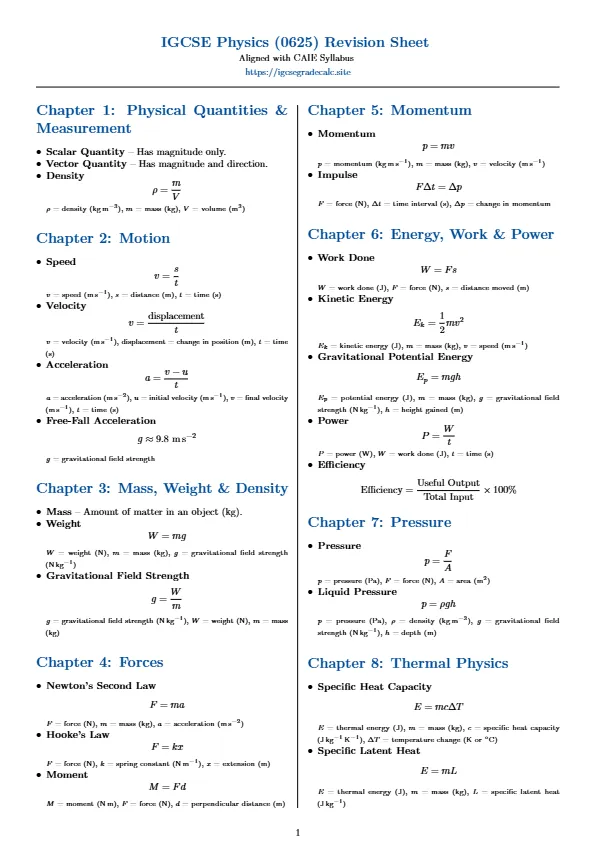
1. Motion, Forces and Energy
Mechanics describes the relationship between mass, velocity, acceleration, energy, and forces within an integrated physical framework.
1.1 Physical Quantities: Vectors and Scalars
- Scalar Quantities: Physical quantities that have magnitude (size) only.
Examples: Distance, speed, time, mass, energy, temperature, density, volume. - Vector Quantities: Physical quantities that have both magnitude and direction.
Examples: Displacement, velocity, acceleration, force, weight, momentum, impulse, electric field strength.
• Magnitude: Apply Pythagoras \(R = \sqrt{A^2 + B^2}\)
• Direction: Apply trigonometry \(\theta = \tan^{-1}(\text{opposite} / \text{adjacent})\)
1.2 Motion (Kinematics)
Speed is the distance travelled per unit time (scalar). Velocity is the speed in a given direction (vector).
| Graph Type | Gradient Represents | Area Under Curve Represents |
|---|---|---|
| Distance-Time Graph | Speed (\(v\)) | N/A |
| Speed-Time Graph | Acceleration (\(a\)) | Distance Travelled (\(s\)) |
Graph Interpretations:
- Distance-Time: Horizontal line = stationary; Straight sloped line = constant speed; Curved upwards = accelerating.
- Speed-Time: Horizontal line = constant speed (zero acceleration); Straight sloped line = constant acceleration; Curve flattening horizontally = non-uniform acceleration (decreasing acceleration).
Acceleration: \(a = \frac{\Delta v}{t} = \frac{v - u}{t}\)
Acceleration of Free Fall: \(g = 9.8 \, \text{m/s}^2\) (near Earth's surface)
1.3 Mass, Weight, and Density
- Mass (\(m\)): Measure of the quantity of matter in an object; resists changes in motion (inertia). Measured in kg. Remains constant everywhere.
- Weight (\(W\)): The gravitational force acting on an object with mass. Measured in Newtons (\(\text{N}\)). Varies with local gravitational field strength (\(g\)).
- Gravitational Field Strength (\(g\)): Force per unit mass (\(g = \frac{W}{m}\)). On Earth, \(g = 9.8 \, \text{N/kg}\).
Density: \(\rho = \frac{m}{V}\)
1. Regular Solid: Measure mass using a balance; measure dimensions with a ruler/micrometer to calculate \(V\).
2. Irregular Solid: Lower object into a measuring cylinder filled with a known volume of water. Displacement = Volume (\(V = V_{\text{final}} - V_{\text{initial}}\)).
3. Liquid: Place measuring cylinder on balance, tare/zero it, pour liquid, record mass and read volume directly.
1.4 Elasticity and Newton's Laws of Motion
Forces can change the size, shape, or speed of a body.
- Hooke's Law: The extension (\(x\)) of a spring is directly proportional to the applied load (\(F\)), provided the limit of proportionality is not exceeded.
- Limit of Proportionality: The point beyond which extension is no longer directly proportional to load.
- Newton's First Law: An object remains at rest or continues at constant velocity unless acted upon by a resultant force.
- Newton's Second Law: Resultant force causes acceleration in the direction of the force (\(F = ma\)).
- Newton's Third Law: If body A exerts a force on body B, body B exerts an equal and opposite force on body A.
- Friction & Drag: Imperfection forces that oppose relative motion and convert kinetic energy into thermal energy.
- Circular Motion: An object moving in a circle at constant speed has changing direction, thus changing velocity and accelerating toward the center. This requires a centripetal force acting toward the center.
Resultant Force: \(F = ma\)
1.5 Turning Effects and Momentum
The moment of a force is a measure of its turning effect about a pivot point.
Momentum: \(p = mv\)
Impulse / Change in Momentum: \(\text{Impulse} = F\Delta t = \Delta p = mv - mu\)
1. Zero Resultant Force: Sum of forces in any direction = 0.
2. Zero Resultant Turning Effect: \(\sum \text{Clockwise Moments} = \sum \text{Anticlockwise Moments}\) (Principle of Moments).
Center of Gravity: The point through which all the weight of an object can be considered to act. An object is stable if its center of gravity is low and its base area is wide, ensuring the line of action of weight stays within the base.
Conservation of Momentum: In any collision or explosion, total momentum before collision = total momentum after collision, provided no external forces act on the system (\(m_1u_1 + m_2u_2 = m_1v_1 + m_2v_2\)).
1.6 Work, Energy, Power, and Pressure
Energy cannot be created or destroyed, only transferred from one store to another (Principle of Conservation of Energy).
- Energy Stores: Kinetic, Gravitational Potential, Chemical, Elastic (Strain), Nuclear, Electrostatic, Thermal, Internal.
- Energy Transfers: Mechanical work, Electrical work, Heating, Radiation (light/sound).
Gravitational Potential Energy: \(\Delta E_p = mgh\)
Work Done: \(W = Fd = \Delta E\)
Power: \(P = \frac{W}{t} = \frac{\Delta E}{t}\)
Efficiency: \(\text{Efficiency} = \frac{\text{Useful Energy Output}}{\text{Total Energy Input}} \times 100\%\) (or Power ratio)
Solid Pressure: \(p = \frac{F}{A}\)
Liquid Hydrostatic Pressure: \(p = \rho gh\)
Energy Resources:
- Renewable: Solar, wind, hydro, wave, tidal, geothermal, biofuel. (Do not deplete, low emissions, variable availability).
- Non-renewable: Fossil fuels (coal, oil, gas), nuclear fuel. (Reliable, high power density, but finite and release CO₂ or radioactive waste).
- Sun as Source: Solar energy powers wind, waves, hydro, and fossil fuels. Exceptions: Geothermal, Nuclear, and Tidal energy do NOT originate from the Sun.
2. Thermal Physics
Deals with thermal properties, heat capacities, macroscopic expansion parameters, and kinetic particle models.
2.1 Kinetic Particle Model of Matter
| State | Arrangement & Distance | Motion | Forces & Energy |
|---|---|---|---|
| Solid | Regular lattice structure, tightly packed | Vibrate about fixed positions | Very strong intermolecular forces |
| Liquid | Random arrangement, closely packed | Slide past one another fluidly | Weaker forces than solids, mobile |
| Gas | Random arrangement, far apart | Rapid, random straight-line motion | Negligible intermolecular forces |
Gas Pressure & Temperature (Microscopic View):
- Gas molecules collide with the walls of a container, exerting a force per unit area, causing pressure.
- Increasing Temperature: Increases average particle kinetic energy and speed \(\rightarrow\) more frequent and forceful collisions \(\rightarrow\) higher pressure.
- Decreasing Volume (at constant T): Particles closer together \(\rightarrow\) more frequent collisions per unit wall area \(\rightarrow\) pressure increases (\(p \propto 1/V\)).
- Absolute Zero: \(-273^\circ\text{C}\) or \(0\text{ K}\). Particles have minimum internal energy and zero kinetic energy.
2.2 Temperature and Thermal Expansion
When heated, solids, liquids, and gases expand because kinetic energy increases, pushing particles further apart. Gases expand most, liquids moderately, solids least.
Boyle's Law (Ideal Gas at constant T): \(p_1V_1 = p_2V_2\)
2.3 Thermal Properties and Specific Heat Capacity
- Internal Energy: Total kinetic energy + potential energy of all particles in a system.
- Specific Heat Capacity (\(c\)): The thermal energy required per unit mass to raise the temperature of a material by \(1^\circ\text{C}\) (or \(1\text{ K}\)). Unit: \(\text{J/(kg}\cdot^\circ\text{C)}\).
During a change of state, temperature remains constant because energy supplied goes into breaking/overcoming intermolecular bonds (increasing potential energy), rather than increasing particle speed (kinetic energy).
• Evaporative Cooling: Highly energetic molecules escape from the liquid surface, leaving lower kinetic energy molecules behind \(\rightarrow\) average kinetic energy drops \(\rightarrow\) liquid cools.
2.4 Thermal Energy Transfers
- Conduction: Thermal transfer in solids via atomic lattice vibrations and diffusion of free electrons (metals are superior conductors due to delocalized electrons).
- Convection: Thermal transfer in fluids (liquids/gases). Fluid expands when heated \(\rightarrow\) density drops \(\rightarrow\) warmer fluid rises, cooler denser fluid sinks, forming a convection current.
- Radiation: Heat transfer via Infrared Electromagnetic Waves. Does not require a physical medium (can travel through vacuum).
• Dull/Matte Black: Best emitters and best absorbers.
• Shiny/White/Silver: Worst emitters, best reflectors.
3. Properties of Waves
Waves transfer energy and information from one place to another without transferring matter.
3.1 Wave Characteristics
- Transverse Waves: Direction of vibration is perpendicular to the direction of energy propagation.
Examples: Water waves, light waves, all EM spectrum waves, seismic S-waves. - Longitudinal Waves: Direction of vibration is parallel to the direction of energy propagation. Consists of compressions (high pressure) and rarefactions (low pressure).
Examples: Sound waves, seismic P-waves.
| Term | Definition | SI Unit |
|---|---|---|
| Wavelength (\(\lambda\)) | Distance between two consecutive matching points on a wave (e.g. crest to crest) | Meters (\(\text{m}\)) |
| Frequency (\(f\)) | Number of complete wave cycles passing a point per second | Hertz (\(\text{Hz}\)) |
| Amplitude (\(A\)) | Maximum displacement of a point on a wave from its equilibrium position | Meters (\(\text{m}\)) |
| Period (\(T\)) | Time taken for one complete wave cycle to pass | Seconds (\(\text{s}\)) |
Frequency / Period Relation: \(f = \frac{1}{T}\)
Wave Phenomena:
- Refraction: Change in wave speed when entering a different density medium, causing direction shift (unless entering along the normal). Wavelength changes, frequency remains constant.
- Diffraction: Spreading of waves as they pass through a gap or around an obstacle. Maximum diffraction occurs when gap size equals wavelength (\(\text{gap} \approx \lambda\)).
3.2 Reflection, Refraction, and Light Optics
Light is a transverse electromagnetic wave.
Refractive Index: \(n = \frac{\sin i}{\sin r} = \frac{c}{v}\)
Critical Angle: \(\sin c = \frac{1}{n}\)
1. Light travels from an optically denser to an optically less dense medium.
2. Angle of incidence is greater than the critical angle (\(i > c\)).
Applications: Optical fibers for telecommunications, endoscopes in medicine.
Lenses:
- Converging (Convex) Lens: Focuses parallel light rays to a principal focus point (\(F\)). Focal length (\(f\)) is the distance from center of lens to \(F\).
• Object beyond \(2F\): Real, inverted, diminished (Camera).
• Object between \(F\) and \(2F\): Real, inverted, enlarged (Projector).
• Object closer than \(F\): Virtual, upright, enlarged (Magnifying Glass). - Dispersion: White light passing through a glass prism separates into rainbow colors (ROYGBIV) because red light refracts least (fastest in glass) and violet refracts most (slowest in glass).
3.3 The Electromagnetic (EM) Spectrum
All EM waves are transverse waves that travel at the speed of light in a vacuum (\(c = 3.0 \times 10^8 \, \text{m/s}\)).
| Region | Main Uses | Main Hazards |
|---|---|---|
| Radio Waves | Radio and TV communications, RFID | None (low energy) |
| Microwaves | Satellite TV, mobile phones, cooking | Internal heating of body tissue |
| Infrared | Remote controls, thermal imaging, grills | Skin burns |
| Visible Light | Vision, photography, optical fibers | Eye damage from high intensity |
| Ultraviolet | Sunbeds, fluorescent lamps, security marking | Skin cancer, eye cataracts |
| X-Rays | Medical imaging, security scanners | Cell mutation, cancer risk |
| Gamma Rays | Cancer radiotherapy, sterilizing medical equipment | Severe cell mutation, tissue damage |
Trend: From Radio to Gamma: Frequency increases, energy increases, wavelength decreases.
3.4 Sound Waves
Sound is a longitudinal mechanical wave caused by vibrating sources. Requires a medium (cannot travel through vacuum). Speed: \(v_{\text{solids}} > v_{\text{liquids}} > v_{\text{gases}}\) (approx. \(330\text{–}350 \text{ m/s}\) in air).
- Pitch: Determined by frequency (higher frequency = higher pitch).
- Loudness: Determined by amplitude (larger amplitude = louder sound).
- Human Hearing Range: \(20 \, \text{Hz}\) to \(20,000 \, \text{Hz}\) (\(20 \, \text{kHz}\)).
- Ultrasound: Sound waves with frequencies higher than \(20 \, \text{kHz}\). Used in medical body scanning, SONAR depth measurements (\(d = \frac{v \times t}{2}\)).
4. Electricity and Magnetism
Covers magnetic phenomena, static charge, electric circuits, and electromagnetic induction.
4.1 Magnetism and Static Electricity
- Magnetic Materials: Iron, Steel, Cobalt, Nickel.
• Soft Iron: Easily magnetized and demagnetized (used in electromagnets, transformer cores).
• Hard Steel: Hard to magnetize, retains magnetism long term (used in permanent magnets). - Static Electricity: Friction transfers electrons between insulators.
• Material gaining electrons becomes negatively charged.
• Material losing electrons becomes positively charged.
• Like charges repel, opposite charges attract. Electric fields point from positive to negative.
4.2 Electric Circuits & Ohm's Law
Electric current (\(I\)) is the rate of flow of electric charge (measured in Amperes, \(\text{A}\)). In metals, current is a flow of free electrons.
Potential Difference (Voltage): \(V = \frac{W}{Q}\)
Ohm's Law: \(R = \frac{V}{I}\)
Electrical Power: \(P = IV = I^2R = \frac{V^2}{R}\)
Electrical Energy: \(E = Pt = IVt\)
IV Characteristics:
- Ohmic Resistor: Straight line through origin (constant resistance).
- Filament Lamp: S-curve. Higher current heats filament \(\rightarrow\) higher resistance \(\rightarrow\) curve flattens.
- Diode: Current flows in forward direction only (after threshold voltage \(\approx 0.6\text{V}\)). High reverse resistance.
- LDR (Light Dependent Resistor): Light intensity rises \(\rightarrow\) Resistance drops.
- Thermistor (NTC): Temperature rises \(\rightarrow\) Resistance drops.
4.3 Series and Parallel Circuit Rules
| Property | Series Circuit | Parallel Circuit |
|---|---|---|
| Current | Same at all points (\(I_1 = I_2 = I_3\)) | Splits across branches (\(I_{\text{total}} = I_1 + I_2\)) |
| Potential Difference | Shared across components (\(V_{\text{total}} = V_1 + V_2\)) | Same across all branches (\(V_{\text{total}} = V_1 = V_2\)) |
| Resistance | \(R_{\text{total}} = R_1 + R_2 + R_3\) | \(\frac{1}{R_{\text{total}}} = \frac{1}{R_1} + \frac{1}{R_2}\) |
• Live wire (Brown): Carries high alternating voltage.
• Neutral wire (Blue): Completes circuit at ~0V.
• Earth wire (Green/Yellow): Safety feature. Connects metal casing to ground.
• Fuse / Circuit Breaker: Melt/trip to disconnect live wire if current exceeds rated threshold, preventing overheating/fires.
4.4 Electromagnetism & Induction
- Right-Hand Grip Rule: Thumb points in current direction, fingers curl in magnetic field direction around a straight wire or solenoid.
- Motor Effect (Fleming's Left-Hand Rule): A current-carrying conductor in a magnetic field experiences a force.
• Thumb = Force/Motion, Index Finger = Magnetic Field (N to S), Second Finger = Current (+ to -). - Electromagnetic Induction: EMF is induced across a conductor when it cuts through magnetic field lines (or when magnetic field changes).
• Magnitude increases with: stronger magnet, faster movement, more coil turns. - Lenz's Law: The direction of an induced current always opposes the change causing it.
Voltage & Turns: \(\frac{V_p}{V_s} = \frac{N_p}{N_s}\)
100% Efficiency Power Conservation: \(I_p V_p = I_s V_s\)
5. Nuclear Physics
Covers atomic structure, radioactive decay processes, and nuclear reactions.
5.1 The Nuclear Atom
Atoms consist of a dense positive nucleus containing protons and neutrons (nucleons), surrounded by orbiting electrons.
| Particle | Relative Charge | Relative Mass |
|---|---|---|
| Proton | \(+1\) | \(1\) |
| Neutron | \(0\) | \(1\) |
| Electron | \(-1\) | \(1/1840\) (negligible) |
Nuclide notation: \({}_{Z}^{A}\text{X}\), where \(A\) is Nucleon Number (Mass Number) and \(Z\) is Proton Number (Atomic Number).
5.2 Radioactivity & Nuclear Radiation
Unstable nuclei decay randomly and spontaneously to become stable, emitting ionizing radiation.
| Property | Alpha (\(\alpha\)) | Beta (\(\beta^-\)) | Gamma (\(\gamma\)) |
|---|---|---|---|
| Nature | Helium nucleus (\({}_{2}^{4}\text{He}\)) | High-speed electron (\({}_{-1}^{0}e\)) | High-frequency EM wave |
| Charge | \(+2\) | \(-1\) | \(0\) |
| Ionizing Power | Very High | Medium | Low |
| Penetrating Power | Low (Stopped by paper/few cm air) | Medium (Stopped by few mm aluminum) | Very High (Reduced by thick lead) |
| Field Deflection | Deflected weakly by electric/magnetic fields | Deflected strongly in opposite direction to \(\alpha\) | Not deflected at all |
Beta Decay: \({}_{Z}^{A}\text{X} \longrightarrow {}_{Z+1}^{A}\text{Y} + {}_{-1}^{0}\beta\)
5.3 Half-Life & Hazards
- Background Radiation: Low-level ionizing radiation present all around us. Sources: radon gas, cosmic rays, rocks, medical equipment.
- Half-Life (\(t_{1/2}\)): The time taken for half the unstable nuclei in a sample to decay, or the time taken for the activity of a sample to halve.
- Safety Precautions: Use shielding (lead containers), maximize distance (tongs), minimize exposure time.
Fission vs Fusion:
- Nuclear Fission: A heavy nucleus (e.g. Uranium-235) absorbs a slow neutron and splits into two smaller daughter nuclei, releasing neutrons and energy.
- Nuclear Fusion: Two light nuclei (e.g. Hydrogen) collide at extreme heat/pressure to fuse into a heavier nucleus (Helium), releasing huge amounts of energy. Powers the Sun.
6. Space Physics
Covers orbital mechanics, stellar evolution, and modern cosmological theories.
6.1 Earth and the Solar System
- Earth's Motion:
• Rotates on its axis once every 24 hours \(\rightarrow\) Day and Night.
• Orbits the Sun once every 365 days \(\rightarrow\) Year duration and seasonal shifts (due to tilted axis). - Moon's Motion: Orbits Earth every ~27.3 days. Phases of the Moon are caused by viewing varying amounts of the illuminated half of the Moon from Earth.
- Solar System Structure: Sun at center \(\rightarrow\) 4 Inner Rocky Planets (Mercury, Venus, Earth, Mars) \(\rightarrow\) Asteroid Belt \(\rightarrow\) 4 Outer Gas/Ice Giants (Jupiter, Saturn, Uranus, Neptune).
Gravitational Field Strengths: Planets with larger mass have stronger gravitational fields at their surface, keeping moons and satellites in orbit.
6.2 Stars and Stellar Evolution
The Sun is a medium-sized star powered by nuclear fusion of hydrogen into helium in its core.
1. All Stars: Interstellar Cloud of Dust & Gas (Nebula) \(\rightarrow\) Protostar \(\rightarrow\) Main Sequence Star (stable due to inward gravity balancing outward radiation pressure).
2. Low-Mass Stars (like the Sun):
Main Sequence \(\rightarrow\) Red Giant \(\rightarrow\) Planetary Nebula \(\rightarrow\) White Dwarf \(\rightarrow\) Black Dwarf.
3. High-Mass Stars:
Main Sequence \(\rightarrow\) Red Supergiant \(\rightarrow\) Supernova \(\rightarrow\) Neutron Star OR Black Hole (if mass is exceptionally high).
Astronomical Distances: A Light-Year is the distance light travels through a vacuum in one year (\(\approx 9.5 \times 10^{15} \, \text{m}\)).
6.3 Cosmology & The Expanding Universe
- Redshift: The increase in observed wavelength (shift toward the red end of the spectrum) of light emitted from distant galaxies moving away from us.
- Key Evidence for Big Bang:
1. Redshift: Galaxies further away show greater redshift \(\rightarrow\) moving away faster \(\rightarrow\) the entire universe is expanding.
2. Cosmic Microwave Background Radiation (CMBR): Microwave radiation received equally from all directions in space, representing thermal energy left over from the Big Bang.
Syllabus Value for Hubble Constant: \(H_0 \approx 2.2 \times 10^{-18} \, \text{s}^{-1}\)
Estimate of Age of Universe: \(t \approx \frac{1}{H_0}\)
What is Cambridge IGCSE Physics (0625)?
Cambridge IGCSE Physics (0625) is a globally recognized science curriculum designed to give students a fundamental understanding of the technological world we live in. By combining rigorous theoretical concepts with practical investigative skills, the course teaches learners how to analyze physical phenomena mathematically and logically. Mastering the IGCSE Physics syllabus requires more than just memorizing formulas; it demands a deep conceptual grasp of foundational mechanics, thermal dynamics, optics, electromagnetism, atomic behaviors, and the newly updated astronomical models in Space Physics.
To excel in the final examinations, students must comfortably navigate three distinct components: core/extended multiple-choice questions (Paper 1 or 2), structured theory papers (Paper 3 or 4), and practical assessments (Paper 5 or 6). Success depends heavily on your ability to apply exact definitions (such as specific heat capacity or half-life), utilize correct SI units, rearrange physics equations under pressure, and interpret complex data graphs. Utilizing high-quality revision notes, tracking your weighted marks using an IGCSE Grade Calculator, and solving past year topical papers systematically are the most reliable strategies for achieving an \(A^*\) grade.
Related sources
Other notes:
- IGCSE History Revision Notes
- IGCSE Chemistry Revision Notes
- IGCSE Sociology Studies Revision Notes
- IGCSE Economics Revision Notes