IGCSE Mathematics (0580)
Syllabus Notes (2025-2027)
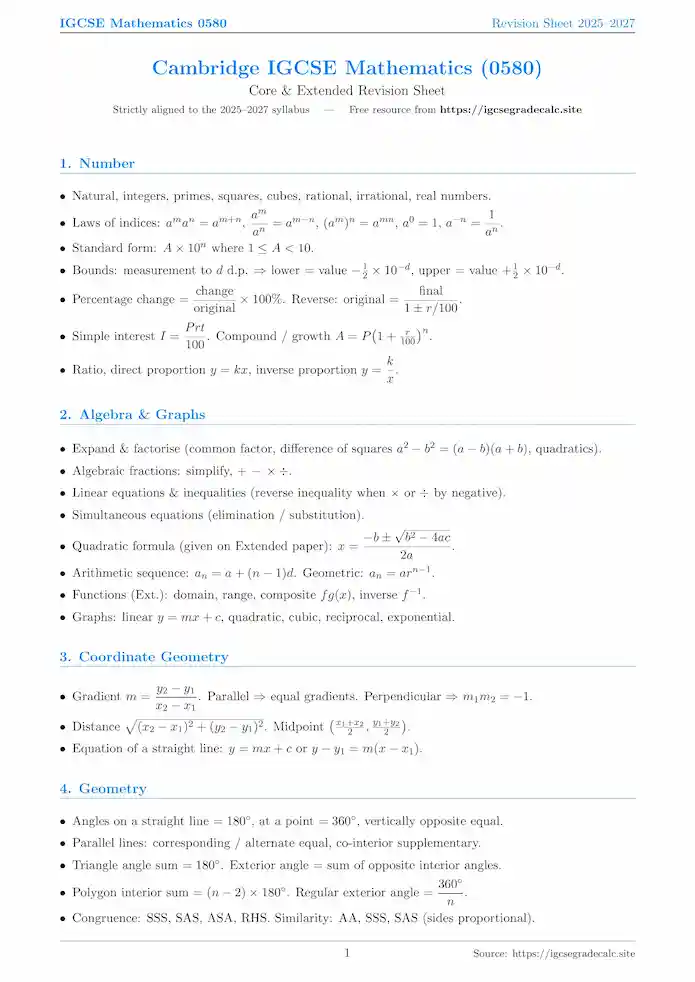
1. Number
Number is the foundation of the entire course. Fluency with the four operations, directed numbers, fractions, percentages, ratios, standard form and bounds is essential for success in every other topic.
1.1 Types of Number
- Natural numbers: 1, 2, 3, … (positive integers starting from 1)
- Integers: …, −3, −2, −1, 0, 1, 2, 3, …
- Prime numbers: Positive integers greater than 1 that have exactly two distinct positive factors (1 and themselves). The first primes are 2, 3, 5, 7, 11, 13, 17, 19, 23…
- Square numbers: \(1^2=1\), \(2^2=4\), \(3^2=9\), \(4^2=16\), \(5^2=25\), \(10^2=100\), \(15^2=225\), \(20^2=400\)…
- Cube numbers: \(1^3=1\), \(2^3=8\), \(3^3=27\), \(4^3=64\), \(5^3=125\), \(10^3=1000\)…
- Rational numbers: Can be written as \(\dfrac{p}{q}\) where \(p\) and \(q\) are integers and \(q\neq0\) (includes all integers, fractions and terminating/recurring decimals).
- Irrational numbers: Cannot be expressed as a fraction of two integers (e.g. \(\pi\), \(\sqrt{2}\), \(\sqrt{3}\), \(\sqrt{5}\)).
- Reciprocal: The reciprocal of a non-zero number \(x\) is \(\dfrac{1}{x}\).
\(a^m \times a^n = a^{m+n}\)
\(a^m \div a^n = a^{m-n}\)
\((a^m)^n = a^{mn}\)
\(a^0 = 1\) (\(a\neq0\))
\(a^{-n} = \dfrac{1}{a^n}\)
\(\sqrt[n]{a} = a^{1/n}\)
\(\sqrt[n]{a^m} = a^{m/n}\)
1.2 Standard Form, Estimation & Bounds
Any positive number can be written in standard form \(A\times10^n\) where \(1\le A<10\) and \(n\) is an integer.
- Example: \(45000=4.5\times10^4\), \(0.0032=3.2\times10^{-3}\)
- Multiply/divide in standard form by handling the \(A\) parts and the powers of 10 separately, then re-adjust if necessary so that \(1\le A<10\).
• Measured to nearest unit → error = ±½ unit
• Measured to 1 d.p. → error = ±0.05
• Measured to 2 s.f. → calculate the place value of the last significant figure and take half of it.
Example: length = 3.2 cm (1 d.p.) → lower = 3.15 cm, upper = 3.25 cm.
1.3 Percentages, Ratio, Proportion & Finance
Percentage change = \(\dfrac{\text{change}}{\text{original}}\times100\%\)
Reverse percentage: Original = \(\dfrac{\text{Final amount}}{1\pm\frac{r}{100}}\)
Simple Interest: \(I=\dfrac{Prt}{100}\)
Compound Interest / Exponential growth or decay: \(A=P\left(1\pm\dfrac{r}{100}\right)^n\)
- Ratio: Simplify ratios by dividing by the highest common factor. Share a quantity in a given ratio by finding the total number of parts.
- Direct proportion: \(y=kx\). Inverse proportion: \(y=\dfrac{k}{x}\). Find \(k\) from a pair of values, then use it to find other values.
- Currency conversion & time: Use given exchange rates; convert between 12-hour and 24-hour clock; calculate time intervals carefully across midnight.
2. Algebra and Graphs
Algebra carries the highest weighting on Extended papers. Mastery of manipulation, equation solving and graph interpretation is essential for high grades.
2.1 Algebraic Manipulation
- Collect like terms and simplify expressions.
- Expand single brackets and products of two (or three – Extended) brackets.
- Factorise by taking out a common factor, difference of two squares \(a^2-b^2=(a-b)(a+b)\), and quadratic trinomials \(ax^2+bx+c\).
- Algebraic fractions: simplify by factorising, then cancel; add/subtract by finding a common denominator; multiply/divide by multiplying by the reciprocal.
Perfect square: \(a^2\pm2ab+b^2=(a\pm b)^2\)
2.2 Equations and Inequalities
- Linear equations: Collect like terms, isolate the variable.
- Linear inequalities: Same rules as equations, but reverse the inequality sign whenever you multiply or divide by a negative number. Represent solutions on a number line.
- Simultaneous equations: Elimination or substitution. For one linear and one quadratic (Extended), substitute the linear expression into the quadratic.
- Quadratic equations:
- Factorisation (preferred when possible)
- Quadratic formula (given on Extended paper): \(x=\dfrac{-b\pm\sqrt{b^2-4ac}}{2a}\)
- Completing the square (Extended)
2.3 Sequences and Functions
Geometric sequence: \(n\)th term \(=ar^{n-1}\) where \(r\) = common ratio
Functions (Extended only):
- Notation \(f(x)\), domain (possible input values), range (possible output values).
- Composite functions: \(fg(x)=f(g(x))\) – apply \(g\) first, then \(f\).
- Inverse functions: \(f^{-1}(x)\) undoes \(f\). Find by setting \(y=f(x)\), rearranging for \(x\), then swapping \(x\) and \(y\).
2.4 Graphs of Functions
- Straight line: \(y=mx+c\) (gradient \(m\), \(y\)-intercept \(c\)).
- Quadratic: \(y=ax^2+bx+c\) – parabola; opens upwards if \(a>0\), downwards if \(a<0\). Turning point can be found by completing the square or differentiation (Extended).
- Cubic, reciprocal (\(y=\dfrac{k}{x}\)), exponential (\(y=ka^x\)) graphs appear on Extended papers.
- Interpret real-life graphs: distance–time, speed–time, conversion graphs, etc. Gradient and area under the curve often have physical meaning.
3. Coordinate Geometry
Length (distance): \(\sqrt{(x_2-x_1)^2+(y_2-y_1)^2}\)
Midpoint: \(\left(\dfrac{x_1+x_2}{2},\dfrac{y_1+y_2}{2}\right)\)
- Parallel lines have equal gradients.
- Perpendicular lines: product of gradients = −1 (i.e. \(m_2=-\dfrac{1}{m_1}\)).
- Equation of a straight line: \(y=mx+c\) or the point–slope form \(y-y_1=m(x-x_1)\).
- Find the equation given two points, or one point and the gradient, or one point and a parallel/perpendicular line.
4. Geometry
4.1 Angle Facts
- Angles on a straight line sum to \(180^\circ\).
- Angles at a point sum to \(360^\circ\).
- Vertically opposite angles are equal.
- Parallel lines: corresponding angles equal, alternate angles equal, co-interior (allied) angles sum to \(180^\circ\).
- Angle sum of a triangle = \(180^\circ\); exterior angle of a triangle = sum of the two opposite interior angles.
- Angle sum of a quadrilateral = \(360^\circ\).
- Interior angle sum of an \(n\)-sided polygon = \((n-2)\times180^\circ\).
- Each exterior angle of a regular \(n\)-sided polygon = \(\dfrac{360^\circ}{n}\).
4.2 Congruence and Similarity
- Congruent triangles (identical in shape and size): SSS, SAS, ASA, RHS.
- Similar triangles (same shape, sides in proportion): AA (two angles equal), SSS (three sides proportional), SAS (two sides proportional and included angle equal).
- Scale factor = \(\dfrac{\text{length in image}}{\text{corresponding length in object}}\). Areas scale by (scale factor)\(^2\); volumes by (scale factor)\(^3\).
4.3 Circle Theorems (Extended)
- The angle subtended by an arc at the centre is twice the angle subtended at the circumference.
- Angles in the same segment are equal.
- Opposite angles of a cyclic quadrilateral sum to \(180^\circ\).
- The angle in a semicircle is a right angle.
- Alternate segment theorem: the angle between a tangent and a chord equals the angle in the alternate segment.
- A tangent is perpendicular to the radius at the point of contact. Two tangents from an external point are equal in length.
5. Mensuration
Many of the key area and volume formulae are printed on the examination paper. You must still know which formula to use and how to rearrange it.
| Shape / Quantity | Formula | Notes |
|---|---|---|
| Area of triangle | \(\dfrac12bh\) or \(\dfrac12ab\sin C\) | Second form Extended (given) |
| Area of parallelogram | base × perpendicular height | |
| Area of trapezium | \(\dfrac12(a+b)h\) | |
| Area of circle | \(\pi r^2\) | Given |
| Circumference | \(2\pi r\) or \(\pi d\) | Given |
| Area of sector | \(\dfrac{\theta}{360}\pi r^2\) | |
| Arc length | \(\dfrac{\theta}{360}2\pi r\) | |
| Volume of prism | cross-sectional area × length | Given |
| Volume of cylinder | \(\pi r^2 h\) | Given |
| Volume of pyramid | \(\dfrac13\times\) base area \(\times\) height | Given |
| Volume of cone | \(\dfrac13\pi r^2 h\) | Given (Extended) |
| Curved surface area of cone | \(\pi r l\) (\(l\) = slant height) | Given (Extended) |
| Volume of sphere | \(\dfrac43\pi r^3\) | Given (Extended) |
| Surface area of sphere | \(4\pi r^2\) | Given (Extended) |
6. Trigonometry
6.1 Right-Angled Triangles
Pythagoras: \(a^2+b^2=c^2\) (where \(c\) is the hypotenuse)
Label the sides relative to the angle you are working with. Use the inverse functions \(\sin^{-1}\), \(\cos^{-1}\), \(\tan^{-1}\) to find angles.
6.2 Exact Values (Extended)
| Angle | \(\sin\) | \(\cos\) | \(\tan\) |
|---|---|---|---|
| 0° | 0 | 1 | 0 |
| 30° | \(\dfrac12\) | \(\dfrac{\sqrt3}{2}\) | \(\dfrac{1}{\sqrt3}\) |
| 45° | \(\dfrac{\sqrt2}{2}\) | \(\dfrac{\sqrt2}{2}\) | 1 |
| 60° | \(\dfrac{\sqrt3}{2}\) | \(\dfrac12\) | \(\sqrt3\) |
| 90° | 1 | 0 | undefined |
6.3 Non-Right-Angled Triangles (Extended)
Cosine Rule (given): \(a^2=b^2+c^2-2bc\cos A\) (and cyclic permutations)
Area of triangle (given): \(\dfrac12ab\sin C\)
Use the sine rule when you have a side and its opposite angle; use the cosine rule when you have two sides and the included angle, or all three sides.
7. Transformations and Vectors
7.1 Transformations
- Translation: Described by a column vector \(\begin{pmatrix}x\\y\end{pmatrix}\). Every point moves the same distance in the same direction.
- Reflection: Mirror image in a given mirror line (e.g. \(x=0\), \(y=0\), \(y=x\), \(y=-x\), or other lines).
- Rotation: Specified by centre of rotation, angle, and direction (clockwise / anticlockwise).
- Enlargement: Specified by centre of enlargement and scale factor. Scale factor \(>1\) enlarges; \(0
7.2 Vectors (Extended)
Magnitude: \(|\mathbf{v}|=\sqrt{x^2+y^2}\)
Addition: \(\begin{pmatrix}a\\b\end{pmatrix}+\begin{pmatrix}c\\d\end{pmatrix}=\begin{pmatrix}a+c\\b+d\end{pmatrix}\)
Scalar multiplication: \(k\begin{pmatrix}a\\b\end{pmatrix}=\begin{pmatrix}ka\\kb\end{pmatrix}\)
Equal vectors have the same magnitude and direction. Parallel vectors are scalar multiples of each other. Position vectors and vector geometry (e.g. mid-point, dividing a line in a ratio) appear regularly.
8. Probability
\(P(A')=1-P(A)\) (complementary events)
Independent events: \(P(A\text{ and }B)=P(A)\times P(B)\)
Mutually exclusive events: \(P(A\text{ or }B)=P(A)+P(B)\)
- Tree diagrams: useful for sequential events (with or without replacement). Multiply along branches for “and”; add different routes for “or”.
- Venn diagrams: useful for overlapping sets. Shade the required regions carefully.
- Conditional probability (Extended): \(P(A|B)=\dfrac{P(A\text{ and }B)}{P(B)}\). In tree diagrams this corresponds to the probability on a subsequent branch.
9. Statistics
- Averages: Mean \(=\dfrac{\sum x}{n}\), median (middle value when ordered), mode (most frequent).
- Range = highest − lowest. Interquartile range (IQR) = \(Q_3-Q_1\).
- Grouped data: Estimated mean \(=\dfrac{\sum fx}{\sum f}\) (use mid-interval values). Modal class is the class with the highest frequency.
- Cumulative frequency: Plot upper class boundary against cumulative frequency. Median is the \(\frac{n}{2}\)th value; quartiles at \(\frac{n}{4}\) and \(\frac{3n}{4}\).
- Box-and-whisker plots: Display minimum, \(Q_1\), median, \(Q_3\), maximum.
- Histograms (Extended): Frequency density \(=\dfrac{\text{frequency}}{\text{class width}}\). The area of each bar (not the height) is proportional to frequency.
What is Cambridge IGCSE Mathematics (0580)?
Cambridge IGCSE Mathematics (0580) is a rigorous, internationally recognised qualification that develops fluency in mathematical techniques, logical reasoning and problem-solving skills. The course is tiered: Core (targeting grades C–G) and Extended (targeting grades A*–C). Extended candidates study all Core content plus additional material (surds, further algebra, circle theorems, sine/cosine rules, vectors, histograms, etc.).
Assessment consists of two papers. Core candidates take Paper 1 (non-calculator, 1 hour) and Paper 3 (calculator, 2 hours). Extended candidates take Paper 2 (non-calculator, 1 hour 30 minutes) and Paper 4 (calculator, 2 hours 30 minutes). A short list of formulae is printed on the question paper; every other formula must be memorised. High-quality revision notes, systematic past-paper practice and accurate grade tracking with an IGCSE Grade Calculator remain the most reliable route to an A* or A grade.
Related sources:
Other notes:
- IGCSE Physics Revision Notes
- IGCSE Chemistry Revision Notes
- IGCSE History Revision Notes
- IGCSE Economics Revision Notes